

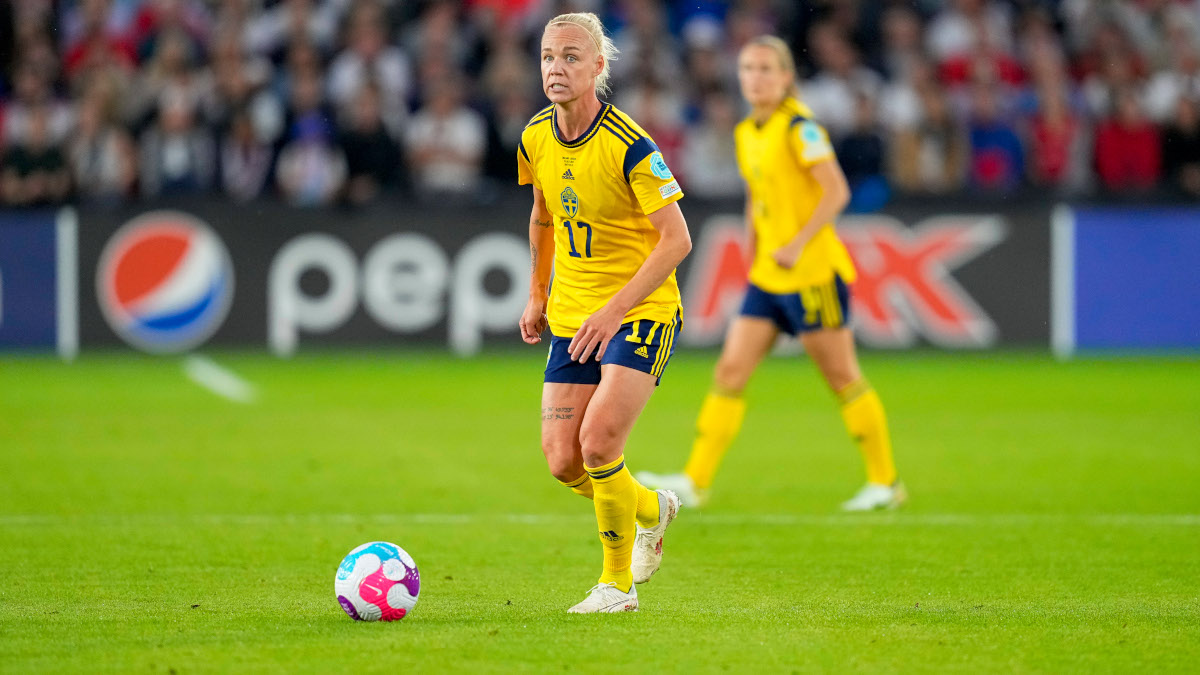
Can Sweden be considered Fifa Women’s World Cup title contenders? With a settled style, elite players in every department and podium finishes behind them at France 2019 and the two most recent Olympics, frankly: how can they not be?

Traditionally, the Swedes are a team that pride themselves on being greater than the sum of their parts. But while that remains their defining ethos, there are nonetheless a clutch of standout world-class individuals within their ranks.
Here, we highlight five of the stars on whom Swedish hopes are pinned.
Filippa Angeldahl
Position: Midfielder
Date of birth: 14 July 1997
While the classy Caroline Seger, Europe’s most-capped player, has been selected for a fifth Women’s World Cup, it is Angeldahl who is now seen as Sweden’s key central midfielder.
The Manchester City midfielder, who will turn 26 the week before Australia & New Zealand 2023 kicks off, comes into the tournament with her status – and confidence - at an all-time high.
A contract extension with City reflects her increasingly influential performances for the all-star English outfit, and her ability to keep possession and dictate play from a deep position is sure to be a feature of Sweden’s campaign.
Stina Blackstenius
Position: Striker
Date of birth: 5 February 1996
Athletic, intelligent and full of energy, Blackstenius first emerged as a superstar-in-the-making when she ripped her way through Uefa and Fifa youth competitions, scoring goals aplenty, as a teenager.
The years since have seen her succeed Lotta Schelin as the most potent attacker in Sweden’s senior side, and her ability and willingness to press makes her the perfect focal point in Peter Gerhardsson’s attacking system. “I always say that one of my best defenders is our centre forward,” he has previously observed.
The Arsenal striker was struggling with injury in the build-up to the Uefa Women’s Euro and, if she can arrive at the Women’s World Cup fit and firing, Sweden’s opponents are all but certain to suffer the consequences.
Magdalena Eriksson
Position: Defender
Date of birth: 8 September 1993
Defensive solidity has always been a point of pride for Sweden teams and, in the current generation, Eriksson is that department’s standard-bearer.
The 29-year-old, who can play on the left but is more often found at centre-back, has been a lynchpin of the Sweden sides that won Olympic silver in Rio and Tokyo, and which beat England to claim World Cup bronze in 2019.
Having established herself as Chelsea captain, and won five English titles during a glittering six-year spell in London, she recently moved to another of Europe’s superpowers, joining Bayern Munich along with her partner, Denmark striker Pernille Harder.
Sofia Jakobsson
Position: Winger
Date of birth: 23 April 1990
Jakobsson has been synonymous with Swedish success over the past decade or so, and was arguably the team’s best player at France 2019. She certainly proved herself as a player for the big occasion by scoring and being named Player of the Match in the victories over Germany and England that paved the way to another World Cup bronze.
Although she is now 33 and approaching her fourth World Cup, the San Diego Wave star – who has previously represented the likes of Chelsea, Bayern Munich and Real Madrid – remains a potent force. Her marauding runs on the right flank seem sure to be a feature of Sweden’s attack at these global finals.
Fridolina Rolfo
Position: Winger
Date of birth: 24 November 1993
On current form, Rolfo is the Sweden player to watch in Australia & New Zealand. She certainly comes into this World Cup playing the best football of an already-impressive career, having capped a stellar season with the goal that won a thrilling Uefa Women’s Champions League final.
Pace, power, panache and a proven eye for goal make the 29-year-old one of the most dangerous attackers in world football right now. If she hits form, and Rolfo’s teammates can rise to her lofty standard, that Champions League winner’s medal might have some company by the end of August.