

Spectators and television viewers are often astounded when they see how many southpaws are fighting in tournaments; sometimes four, five or more.
No comparative statistics are available, but long-time observers agree that there are now more really good “lefties” than ever before. This may, incidentally, also be the case in cricket, tennis and other sports.
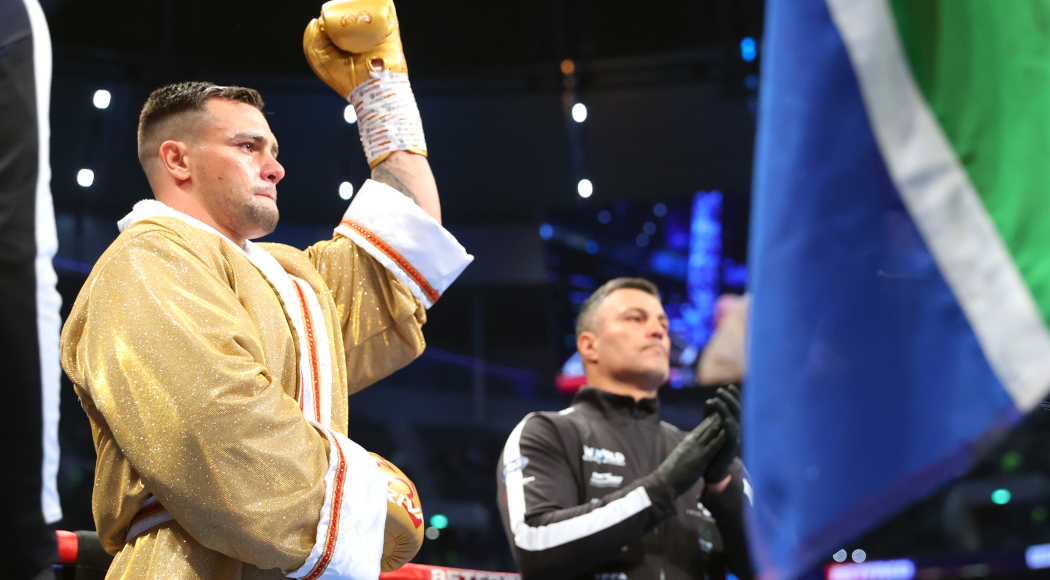
One of South Africa’s most successful fighters in recent years Kevin Lerena 28-2; 14 fights from the southpaw stance.
On Saturday night at Emperors Palace near Kempton Park he meets the capable Ryad Merhy 31-1; 26 from France in a WBC bridgerweight title eliminator.
The Bridgerweight class (91.17kg to 101.60kg) was only recently introduced by the World Boxing Council, the only organisation to recognise the weight class.
Some of the outstanding southpaws in recent years are Guillermo Rigondeaux (who won the WBA and WBO super-bantamweight titles) as well as former eight-division champion Manny Pacquiao, Shinsuke Yamanaka, WBC bantamweight champion, and Takashi Uchiyama, the WBA super-featherweight champion.
The word “southpaw”, according to one popular theory, comes from baseball. It is said that “Ballparks” were designed for the batters to face east so that they did not have to look into the late afternoon sun.
With the pitchers operating from east to west, the left-handers used the “paw” on the south side of their bodies. Their right hand and right foot were, therefore, in front of their body, similar to the stance of Southpaw boxers.
However, etymologists say the word “southpaw” was used years before baseball was first played.
One of the earliest southpaws of note was Ned Turner, a prizefighter in the era of bare-knuckled boxers. He weighed about 65 kg and boxed from 1810 to 1824 and was often against much heavier opponents.
Turner was born in London in 1791 but because his parents were from Wales he was often referred to as a Welshman. He died in 1826.
LEFT-HANDED PIONEER
William Thompson, known as “Bendigo” and born in Nottingham on 11 October 1811, was one of the earliest Southpaw champions. He won the England championship twice, on 12 February 1839 when he beat James “Deaf” Burke and on 9 September 1845 when he defeated Ben Caunt.
Thompson retired after winning the title for the first time because of a knee injury. He was 34 when he fought Caunt, who went down without being hit and was disqualified in the 93rd round.
After bare-knuckle boxing made way for the “gloved” era, Tiger Flowers became one of the best-known southpaws of his time. The “Georgia Deacon” became the first black man to win the world middleweight title when he beat Harry Greb on points over 15 rounds in February 1926.
He lost the title to Mickey Walker and died in New York on 16 November 1927 after an eye operation.
Freddie Miller, who fought from 1927 to 1940 and compiled a record of 212-27, with six draws, one no-contest and 44 wins inside the distance, was an outstanding left-hander.
He won the National Boxing Association’s version of the world featherweight title by beating Tommy Paul on points in January 1933. He made three defences before beating Britain’s Nel Tarleton to gain full recognition as world champion in June 1935.
Miller defended the title five times before losing it to Petey Sarron in May 1936.
OTHER CLASSY SOUTHPAWS
Kayo Morgan – born Andre Ettore Esposito on 12 May 1909 – was the son of Italian parents who lived in Connecticut. A classy southpaw, he made his debut at the age of sixteen. He never won a world title but fought champions such as Panama Al Brown, Sixto Escobar and Benny Lynch in a 142-fight career.
Lew Tendler also never won a world title but was one of the best southpaws of his time, competing in 171 fights between 1913 and 1928. He took world lightweight champion Benny Lenard to close decisions in two fights.
Al McCoy won the world middleweight title in April 1914 when he knocked out George Chip in the first round. Also a Southpaw, he remained champion until he was knocked out in the sixth round in a fight against Mike O’Dowd in November 1917.
According to the Ring Record Book, Harry Greb, who had 299 fights, won and lost the world middleweight title to Southpaws. He beat Johnny Wilson on points in August 1923 and lost over 15 rounds to Tiger Flowers in February 1926.
Among the southpaws who won world titles after Greb were welterweight Lou Brouillard (1931 to 1932), lightweight Juan Zurita (1944 to 1945), bantamweight Jimmy Carruthers (1953 to 1954) and junior lightweight Flash Elorde (1960 to 1964).
Then came junior welterweight Duilio Loi (1960 to 1963) who finished with a record of 115-3, including only eight knockouts, flyweight Hiroyuki Eibihara (1963 to 1964), featherweight Vincente Saldivar (1964 to 1970) and junior welterweight Sandro Lopopolo (1966 to 1967).
Another excellent Southpaw was three-time light-heavyweight champion Marvin Johnson who fought from 1973 to 1986 and beat Mate Parlov for the WBC title, Victor Galindez for the WBA title and Lesley Stewart for the vacant WBA title.
HAGLER, CALZAGHE AND CAMACHO
Two of the best left-hand champions were middleweight Marvin Hagler (1980 to 1987) and lightweight Pernell Whitaker (1989 to 1991).
Ronald “Winky” Wright held the WBO and WBC middleweight belts and Joe Calzaghe was another fine “lefty”.
The Welshman fought from 1993 to 2008 and finished with a record of 46-0 after winning 21 title fights as WBO super-middleweight and IBF, WBA and WBC super-middleweight champion.
Naseem Hamed, who held various titles between 1995 and 2000, was regarded for a while as the No 1 featherweight in the world, His only loss in 37 fights was to Marco Antonio Barrera. Hamed made 15 successful defences of his titles.
Hector Camacho, also a highly rated southpaw, lost six times in 88 fights but won titles in the super-featherweight, lightweight and super-lightweight classes.
Cruiserweight Antonio Tarver won the light-heavyweight crown four times. And Argentina’s Sergio Martinez, who retired recently, won a version of the middleweight title.
INCOMPARABLE PACQUIAO
But none of them achieved what Manny Pacquiao did. The Filipino, a future Hall of Fame hero, has won ten versions of “world” titles in eight divisions. He will be remembered as one of the best Southpaw champions in history.
Orthodox boxers often try to avoid southpaws because of their “abnormal” stance. They have good reason to do so, as shown when South African Corrie Sanders knocked out Wladimir Klitschko to claim the WBO heavyweight belt in the second round in March 2003.
In years gone by, when there were not as many Southpaw boxers as there are now, some trainers even tried to convert “lefties” to the orthodox stance, saying theirs was an incorrect way of boxing.
Among the world champions who from southpaw to the orthodox stance were James J Corbett, Carmen Basilio and Oscar De La Hoya.
Lerena’s southpaw stance could work in his favour against Merhy.