

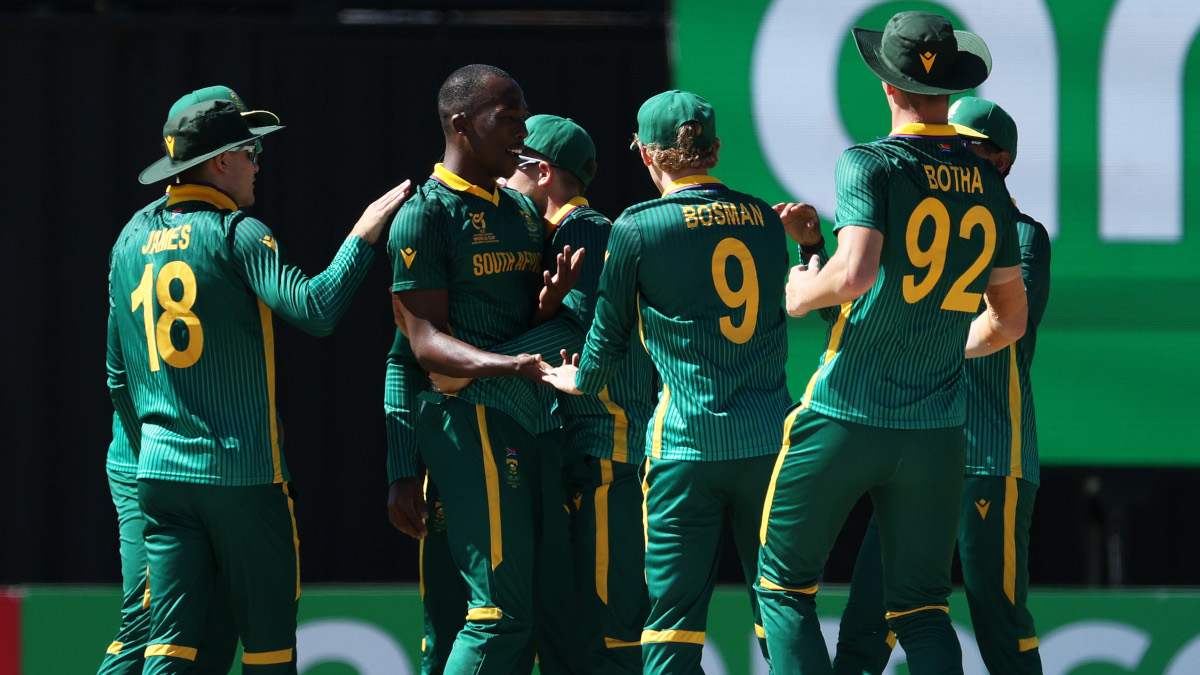
The men’s Under-19 World Cup would appear to be the natural springboard to an international career for many, even a majority of those who are selected to represent their country at such a young age.
The current edition, being hosted by Zimbabwe and Namibia, is the 25th edition of the tournament which was first staged in South Africa in 1998 – then called the Youth World Cup.
If ‘success’ is to be measured in the number of young players who progress to higher international honours rather than winning the tournament, then results have been mixed.
Since the 2006 edition, 32 players from South Africa’s Under-19 squads have progressed to represent the Proteas. Around 10 per cent.
If that seems surprisingly low, it’s because it is. But it’s not as simple as that, inevitably.
In 2008 there were six graduates from the squad which achieved ‘full honours’ and in 2014, when Aiden Markram’s team won the junior World Cup, no less than seven went on to represent their country at senior level.
In 2010 and 2020 however, there were none. Colin Ackermann was a member of the 2010 squad and has represented the Netherlands with aplomb but otherwise they were blank years.
Ackermann represents one very good reason why more South Africans haven’t represented the country of their birth.
Rewind to the first edition in 1998. Seven of the XI who won the Plate final that year played full international cricket. Two of them, Grant Elliott and Michael Lumb, did so for New Zealand and England.
Jon Kent, Morne van Wyk, Robin Peterson and Victor Mpitsang played for South Africa, as did Jacques Rudolph.
Rudolph is a example of another peculiarity of age-group cricket. Some players, and their coaches, don’t yet know what they ‘are’.
Rudolph batted at number 10 as a specialist legspinner. Two years later he was batting at No 3 with his bowling reduced to part-time.
In the team of 2000 Rudolph was preceded in the batting order by Graeme Smith and Andrew Puttick and followed by Johnathan Trott who became one of England’s finest test batsmen.
DESTINED FOR GREATNESS
Seamer Johan Botha was in the middle order and, bringing up the rear at number 11, a fast bowler of rare pace who couldn’t bat much – Albie Morkel.
In 2002 Hashim Amla emerged as an obvious talent destined for greatness.
Stephen Cook and Ryan McLaren also went on to play for South Africa while ‘keeper Davey Jacobs could easily have done so but played almost 100 first-class games and enjoyed a profitable professional career.
Fast bowler Ian Postman, however, played just a single first-class game – for the SA Academy against Sri Lanka ‘A’.
There is at least one, and as many as six in every squad for whom the opportunity led to nothing.
In 2004 Vaughan van Jaarsveld was touted as the next ‘great’ and, although he played international cricket, never lived up to the hype.
Vernan Philander was a batting allrounder at No 5 who bowled ‘useful’ medium pace.
Neither he nor the coaches knew what bowling genius lay within.
Craig Alexander was one of the most promising fast bowlers of his generation and took 376 wickets in 130 first-class games but never quite fulfilled his potential.
He was talented enough to play test cricket, but the margins are fine between good and very good.
Two years later, in the 2006 edition of the tournament in Sri Lanka, Richard Levi and Dean Elgar emerged blinking from the sunlight of their youth along with Craig Kieswetter who, like Lumb eight years earlier, became a T20 World Cup winner with England.
Also in that squad was Pieter Daneel who played just three first-class games for Boland after the tournament making a century and a 50 in 287 runs at an average of 47.83. And that was it.
Some young players are selected for under-19 representation when cricket is no more than an enjoyable pastime at which they happen to excel.
More are ambitious to make the game a career but cannot find an opening in the first-class game.
It took almost three years for Markram to find an opening in the Titans team following the 2014 triumph.
Progress from ‘youth’ to adult cricket is not a precise science. Many would say it is not a science at all, requiring as much luck and good ‘contacts’ as runs and wickets.
Good luck to this generation, and all who follow.