

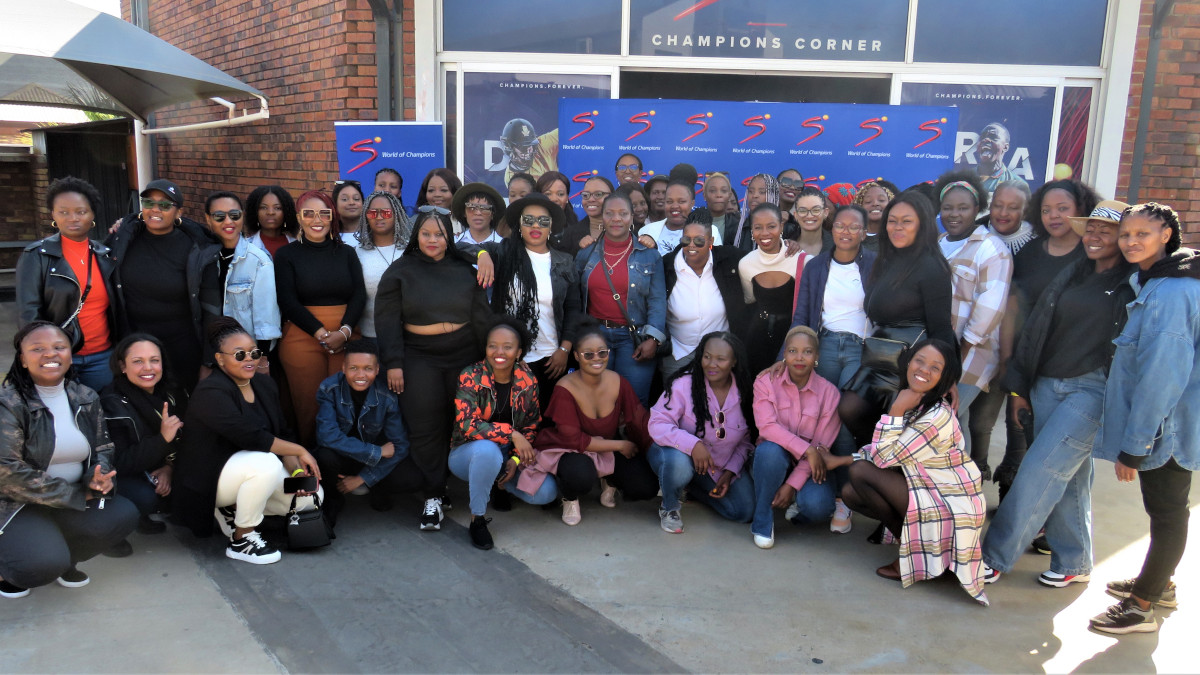
When the Netball World Cup begins in Cape Town next week, a quiet revolution will take hold alongside the courts and adjacent venues.
As host broadcaster of the event, SuperSport will be transmitting the action live to viewers across the world. A special veneer has been added with confirmation that the Pan-African broadcaster will be doing so with a women’s crew of 250.
This is the first time globally that an all-women’s crew has been assembled for a World Cup broadcast and is acknowledgment both of emerging and established female talent and SuperSport’s commitment to harnessing this excellence.
“As a media organisation, SuperSport has a responsibility to continue promoting gender equality and women’s representation in sport,” said Dheshnie Naidoo, head of production operations, who added that the idea of an all-women’s production crew first took hold during a SuperSport exco meeting as an idea to differentiate the business’s offering to other broadcasters.
“Women had limited opportunities to work in various roles behind the camera, and there was a growing awareness of the need for greater representation and inclusion. This opportunity presented the ideal platform for SuperSport. This included me advocating for the creation of an all-women's operational crew to provide opportunities for female crew members. Our then CEO Marc Jury raised the bar and encouraged an all-female crew.”
This presented immediate challenges, not least identifying and selecting skilled and capable operators who could be fast-tracked into the desired levels of operations with a tight deadline. This involved scouting women from various regions and African countries and assessing their abilities to ensure a well-balanced team.
Training was rigorous. SuperSport produced 200 live local netball games for the women to train on under the supervision of industry leaders and broadcast professionals together with coaches and mentors.
They were constantly assessed and offered further training in areas of development.
Building effective communication and team work among the crew was critical: teams from diverse cultural backgrounds require communication and an understanding of the challenges required for effective coaching and management strategies.
Naidoo pointed out that while there was a gender skew, this didn’t necessarily require fundamental shifts in working chemistry or day-to-day dynamics.
“Working with a female crew and a male crew can have some differences, but it’s important to recognise that these differences are not inherently tied to gender itself. They are related more to individual personalities, communication styles, and team dynamics.
“It’s essential to avoid generalising based on gender stereotypes as each person’s behaviour and approach to work are unique. Feeling valued and respected within the team is crucial for overall productivity and job satisfaction.”
The netball itself promises to be compelling and SuperSport aims to offer viewers a complete viewing experience, ensuring they don’t miss any crucial moments.
With netball popular across the continent, expectations are that the World Cup will attract significant viewership and activate a bigger fan base.
SuperSport will deploy advanced production technology and innovative ways to enhance the viewers’ experience during the NWC. This includes various camera angles, statistics, graphics, and interactive features to keep the audience engaged.
Happily, the drive to empower women in the broadcast environment will be ongoing: SuperSport is already planning similar broadcasts with other sporting genres.
THREE WOMEN, THREE STORIES
Adelaide Moeng
Approaching her 30s, Adelaide Moeng has led a varied and vibrant career, dabbling in many areas of media, including roles as production coordinator, production manager, content producer, videographer, photographer and social media and marketing freelancer.
The collective skills she has acquired will now be put to good use at the Netball World Cup where she will work as a camera operator. Her shots, selected by the broadcast director, will help tell the story of the matches.
She’s excited at the prospect. “It’s a unique environment in that most outside broadcasts only have men, so for us to work together as women brings a new energy and perspective on how to merge our ideas and skills. It’s been pleasant and I’ve learned a lot.”
With heroes like Serena Williams and Bongiwe Msomi, the Proteas captain, it’s not surprising that Moeng is looking forward to filming many of netball’s best talents when the World Cup gets going later this week.
“We’ll be seeing the best of the best from each country . . . the techniques and strategies from some of the most athletic people in the world.”
She’s quick to remark that her journey hasn’t been hers alone and pays due thanks to those who have helped along the way. “I have had many mentors, both male and female. I’ve had help from audio people, engineers, directors and even the EVS department [which creates and provides slow- and ultra-motion replays and instant graphics as they produce on-the-fly highlights packages for TV broadcast].
“We all work together to ensure we deliver the highest quality work. I thank them all for being so patient and understanding in teaching and upskilling us all.”
Fatima “Fattz” Kgomo
According to Fatima Kgomo (30), the broadcast industry is known to be cut-throat and predominantly male. Yet when SuperSport recruited her to be part of this “revolution”, she was immediately inspired.
“I was going to be part of history in the making, so why not? It’s entirely up to us as the pioneers to inspire the next generation of young girls and women who will be stepping into this world. It up to us to become role models and idols. We are the face of a world that allows women to be great at what they do. To be seen.”
Growing up, Kgomo wanted to be in the entertainment industry. Hoping to be an actress, she attended acting classes from a young age and attended an art school and varsity to train. Yet midway through varsity she fell in love with television production.
“I walked into the TV studio and I walked out with a new dream of becoming a global female television director. And that is still my dream, that is the end goal.”
Before working for SuperSport she was involved in shooting reality television, live music festivals, awards shows and the like. A floor manager on one production and a director of production on the next, she was called a “Jack” of all trades, a suitable title given her all-round skills in the technical and operations side of the business.
She has freelanced for SuperSport for the past 11 months and although possessed with a variety of skills – floor managing, camera operating and technical directing – she will be utilised as an audio assistant to ensure the best sound clarity for viewers around the world.
“My job is to provide the necessary equipment on the floor to ensure the objective; from presenter and coach microphones to the effect microphones on the court. We also technically assemble the commentary booths with the right equipment and a monitor that has the programme feed and statistics to aid our commentators.”
For all her inner drive and ambition, she credits Tsholofelo Mashea, her biggest supporter, for being her great mentor.
“One of the best entertainment technical directors in the country, he was the one person who taught, trained, and gave me numerous opportunities to become technically the best I know myself to be in this industry. He believes in me and my dreams , my goals, and my future. A great friend, a brother, and an amazing mentor.”
Despite her passion for the job, and the assignment at hand, she professes to having little sporting prowess. “I never played netball or any sport that required me to run because I just can’t run,” she quipped. “I’m not built for it. I’ve got two right feet.”
A big admirer of Caster Semenya, Kgomo says she is looking forward to the experience and atmosphere of the Netball World Cup and “working with the girls”.
“The biggest thing, however, is that I’m looking forward to not stopping this train of revolution. I’m looking forward to working more with women for many other sporting events and productions. This can’t be a one-time thing, but the beginning of a new era of women in sport broadcasting.”
With that, she quotes the words of the great Queen B (Beyoncé):
Who are we?
What we run?
We run the world
Who run the world? Girls!
Nasiphi Debe
As a young girl, Nasiphi Debe wanted to be a journalist because she desired to be in a profession that merges her passion for advocacy with creative and artistic self-expression. Her dream was to write stories that could act as a driving force for social change.
Her journey to this point, as a vision controller for SuperSport, might have been somewhat different, but her role within the bigger women’s team is part of a driving force within the local television industry.
She has strong views on both the historical nature of the TV environment, being strongly skewed to male, and the residue of apartheid.
“Despite significant efforts to address the legacy of apartheid and reduce inequality, South Africa remains one of the most unequal countries in the world. Within our industry, sport broadcast, women continue to face challenges, as they are not the preferred choice for crew position,” says Debe.
“If it weren't for the specific intention to have an all-female crew, I believe I wouldn’t have been chosen for a World Cup placement, even with equal experience compared to my male colleagues. Initiatives like [the SuperSport campaign] ‘Here for Her’ are crucial in ensuring women have equal access to opportunities as they actively promote transformation and gender equality in a sector that was traditionally male-dominated.”
Having completed studies in video technology at the Durban University of Technology, Debe joined SuperSport as an intern in November 2020.
She has since developed strong skills as a vision controller. Her department works closely with the camera operators and the director to ensure that all cameras are set up to deliver the desired shots for each production and that all camera feeds are visually and technically compliant to national and international broadcast standards.
Her heroes, perhaps surprisingly, are not easily-named iconic figures. Debe says that her greatest inspiration comes from watching development-level athletes, the underdogs, and the ambitious dream chasers.
Since being immersed in the netball drive, she has gone from being “clueless” about the sport to a super fan who cannot wait for the experience. “I want to excel on the international stage among an incredible team.”
When she does, she will give a nod to her mother Nomzekelo, who is her drive. ”It has taken multiple generations to pave the way for me to have access to opportunities such as this.”