

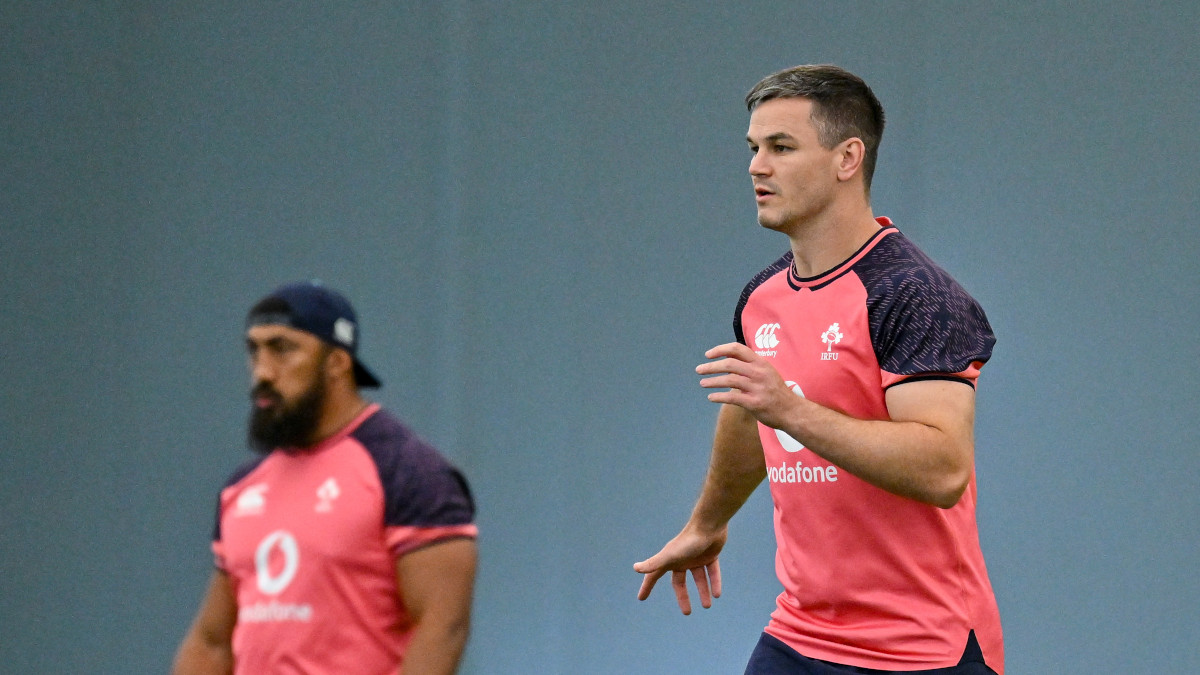
The decision of the European Professional Club Rugby disciplinary to ban Johnny Sexton for three games and keep his World Cup dream alive has not only created a damning precedent that could come back to haunt the game, but is a slap on the wrist by a sport trying to combat referee abuse.
Whether it was intended or not, the decision looks as if it was tailor-made to allow Sexton to play in the Rugby World Cup and avoid missing any games of consequence. The decision, which sees him miss Ireland’s three warm-up games, opens up the chance to close his impressive career at the World Cup without the sanction that many had thought was coming to him.
The independent Disciplinary Committee, comprised Christopher Quinlan KC, Chair, (World Rugby Independent Judicial Panel Chair), Adam Casselden SC (former Chair SANZAAR Judicial Committee) and Marcello D’Orey (former International Rugby Player) gave Sexton a literal slap on the wrist for his behaviour.
According to the committee’s own findings, Sexton’s behaviour was “aggressive towards and disrespectful of the match officials.”
From the committee’s own statement: “it included his pointing his finger at them and shouting at them something to this effect: "it’s a disgrace you guys can't get the big decisions right" probably accompanied by expletives "most likely the f-word". His conduct was obviously unsportsmanlike and brought the sport of rugby union into disrepute.”
Sexton will now miss Ireland’s warm-up games against Italy, England and Samoa and is free to play on 27 August 2023, just before the start of the Rugby World Cup.
Unfortunately the disciplinary committee’s decision - which reads much more damning than the eventual ban handed out, leaves the impression that Sexton got off lightly and that the three match ban was tailored to ensure he competes in the World Cup.
For one, the committee accepted the match officials evidence that Sexton had approached them three times after the game, namely:
(1) In ‘incident 1’, shortly after the end of the Match, Mr Sexton approached the match officials and on three separate occasions gestured towards them and/or spoke to them inappropriately (including at least - as acknowledged in the letter from the Club dated 23 June 2023 - stating that it was a “disgrace the match officials had not got the big decisions right” and using an “expletive” while doing so); and/or
(2) In ‘incident 2’, at the start of the medals presentation, while accompanied by a young child, Mr Sexton stood behind the match officials, looking at them and directing further inappropriate comments at them; and/or
(3) in ‘incident 3’, after the medals presentation, Mr Sexton approached the match officials and followed them a short distance as they left the field before walking away. “
While the disciplinary committee said the conduct was serious and that while not being satisfied with the third incident conducted misconduct, found him guilty on the first two and added the following aggravating factors:
It was a public display of disrespect for the authority of the match officials:
i. While his words may not have been heard, it was clear from his body language and gestures that he was confronting the match officials.
ii. That confrontation happened on the pitch, in the full sight of the packed stadium, at the end of a prestigious match shown live on television.
It was not a fleeting incident:
i. He walked some distance to the match official and had to be moved on by one of them.
ii. The staring and conduct thereafter was contemptuous of the match official and, in the context of what happened in Incident 1, obviously so.
It is not a single incident. Incident 2 aggravates Incident 1.
He is a high-profile player who thereby attracts attention. His words and actions are of more interest, are more noticeable and have a greater capacity to been seen and so to cause harm.
But by taking Sexton’s record, his apology and the fact he had retired from club rugby into account, the ban was reduced to three matches - “meaningful matches” - as the committee put it.
Compare this to other decisions - such as Dylan Hartley receiving an 11-week ban for similarly abusing a ref, the two match suspension of Kyle Sinckler for asking a ref “Are you f***ing serious?” and the ban handed out to Rassie Erasmus for his video during the British and Irish Lions tour and it seems to be a very light punishment indeed.
The biggest problem with this is on the one hand World Rugby preach respect towards referees, but on the other it seems they are selective when imposing sanctions against those who cross the line.
From Dave Rennie’s salvos against referees, to Kieran Crowley and others who have openly criticised referees without sanction, some figures tend to get away with it, while others are heavily sanctioned.
The ruling also sets a massive precedent, and could be used by those who transgress in future to lean on when they cross the line.
And in the wake of the abuse that Ben O’Keefe suffered after the Super Rugby final, will hardly do anything to stop referees being abused in future.
What is done is done, but it is hard to shake the feeling that the decision was tailored for Sexton to go to the World Cup, at the expense of rugby’s values and norms.
And that may be the biggest damage to the sport from the incident.