

CAPETONIANS ALSO KNOW FOUR LETTER WORDS
While feasting on the atmosphere of the Cape Town Stadium, sorry DHL Stadium, before kick-off to the deciding game in the Castle Lager Test Series, it was hard not to once again lament the inability of World Rugby to find a way to postpone the 2021 Lions series.
The three games played just under a year ago were played in an empty stadium and therefore all of the games were soulless affairs that probably ratcheted up the spitefulness that series will be remembered for.
Okay, so if it wasn’t for Covid, and the tour was postponed until now, like it should have been, we wouldn’t have seen all the games in the series played at the Cape Town venue. But we would have seen the first one, and what an occasion that would have been.
The stadium in Greenpoint has seen some good times lately, with the Stormers winning a United Rugby Championship final there just a month ago. But the test match atmosphere ratcheted up another level, not just at the stadium itself during the game but also in the eateries and drinking establishments around the ground, along the Mouille Point/Granger Bay and Sea Point beachfront.
I didn’t get to the V and A Waterfront, for I’m unfortunately human and therefore don’t have the capacity to eat in more than one place at one time, but I’d imagine it was heaving there too.
Unfortunately, as sometimes happens when a different organisation takes over something that is usually run by the locals, getting into the stadium was a nightmare for me and the colleagues who traveled with me. In the sense that the usual easy entrance to the P1 parking was closed off and we got redirected along a route that took us in the opposite direction to the stadium. Couldn’t someone have told us that was the case?
So that wasted an hour and prevented me from getting to the stadium in enough time, after a really good Paella lunch at a seaside restaurant, to check out the beer gardens and other entertainment on the concourse around the stadium. But I’d imagine that was pretty swell too.
I wrote in my last diary entry that it would be hard for the Cape Town atmosphere to eclipse that of Bloemfontein the week before, and I will stick to that. Let’s call it a draw, though I do think Bloemfontein was marginally more electric and boisterous. That might be down to the acoustics at Cape Town Stadium, something I first questioned when attending a U2 concert there in 2011 or 2012. I remember leaving that event thinking that a U2 concert in the old Greenpoint Stadium 13 years earlier had been way better and that next time I saw Bono sing I’d prefer it to be in a marquee.
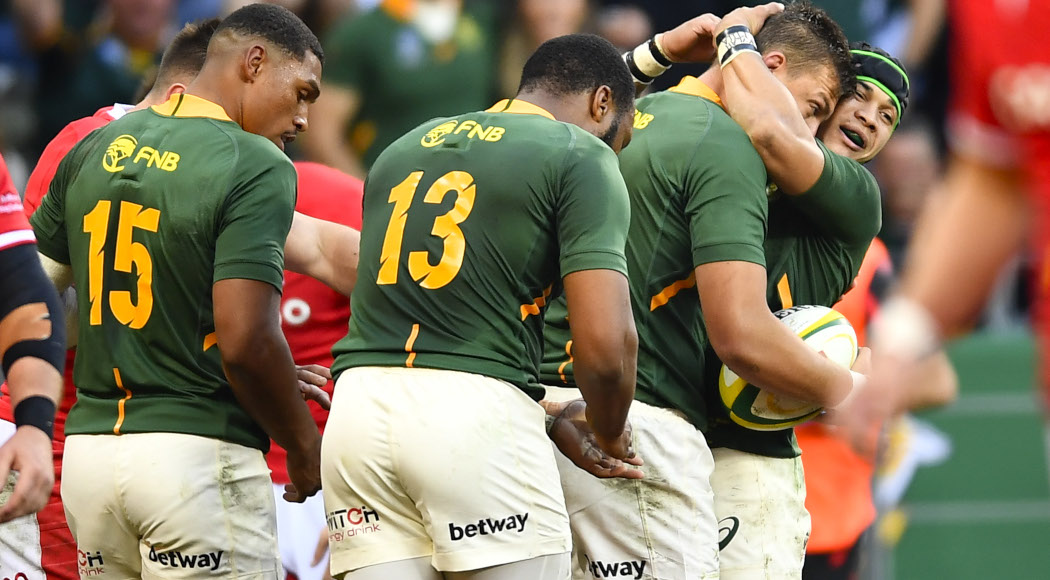
Similar songs were played over the loudspeakers to what we heard in Bloemfontein, and this time the Bob Marley reggae song “Don’t worry, about a thing” was perfectly apt. There was never any doubt the Boks would win this one, even though the Welsh do deserve to be lauded for their simple refusal to die.
And I can happily report that along with a love for reggae, the people of Cape Town do know how to swear, for they played ball when the DJ left a gap for them to chorus in on that old Smokie hit with “Who the F… is Alice”. Well done lads and lasses, well done!
EDDIE HAD THE RIGHT MOAN THIS TIME
Back when Eddie Jones was coaching Australia, and before the Wallabies fans started to think of him as a traitor, there was a South African hack who nicknamed him Eddie Moans. He does moan a lot, but the now England coach had a moan last week that I am in complete agreement with.
I’m referring to the one where he called for World Rugby to convene an urgent summit of leading players, coaches and referees to discuss how to enhance international rugby union as a spectacle, and where he said he’d “had enough” of the game’s increasingly stop-start nature.
When England were here in 2018 I was MC at an event at the Villagers rugby club where Jones was the guest of honour and I was tasked with interviewing him in a session that ran to over an hour. It was all off the record, but he said pretty much the same things there that he has put on the record now. That was four years ago, and he’d already had enough, so full marks to him for having the patience to wait until now.
While right now South Africans appear to be hungry for live international rugby, with record crowds for a series against Wales at all three test matches played over the past fortnight, there can be no denying the negative impact that the prevalence of cards is having on the sport. As well as the inordinate amount of time that it sometimes takes for TMOs and referees to consult over incidents that need to review.
On that last point I can’t understand why it can’t operate like VAR does in soccer, as in play continues until a decision is made. And on the first point it is hard to understand why the simple solution of having players who are red carded for technical offences, or mere accidents as is frequently the case, be replaced by players from the bench has not been tried out.
It was tried out in what I think was called the Preparation Cup, the competition that preceded the Rainbow Cup, in 2021, and it appeared to work okay. The team that had a player red carded would go 20 minutes with a disadvantage in numbers, and then the player would be replaced. It still hurts the red carded player’s team in the sense that it throws his coach’s substitution plan out, but at least you then preserve some of the integrity of having 15 against 15.
The drive to make the game safer, particularly when you hear of ex-players suffering early onset dementia as a legacy of being concussed during their playing careers, is understandable. But it is being taken too far, and sending players off because they were involved in an accidental clash of heads, is lunacy. The drive to make the game safer shouldn’t be allowed to destroy it. Rugby is a contact sport and everyone who plays it surely knows the risks, just as, for instance, a downhill mountain biker knows that the slightest error could have the most grievous consequences.
I ran five Comrades Marathons and after every single one of them I woke up the next day feeling as if an elephant had fallen on me. Did I think of suing the Comrades organises? Not on your nelly. And they weren’t paying me to run that tortuous race, where occasionally it felt like there might be vultures circling over my moving carcass. Instead I paid them for the privilege of having that experience.
Jones is right in suggesting that rugby is losing its essence and the summit of players, coaches and referees that he is calling for is long overdue.
STILL FEELING SORRY FOR THE REFS
Last week I spoke about how I felt sorry for Jaco Peyper for having to preface a red card with the word “unfortunately”, this week it is English referee Wayne Barnes I feel sorry for. He is being pilloried by some New Zealand critics for not sending off the Irish prop who broke Brodie Retallick’s cheek bone in an accidental collision, and the critics are right: If the one the week before was a sending off offence, so was that one.
But Barnes clearly agrees with me that the law is an ass. Later in the game, when the Irish were confounded that they had to take a scrum even though the halftime hooter had sounded, he said: “It is a silly rule, but it is a rule”. There are too many silly rules…
TREAD WARILY AROUND THE ALL BLACK CRISIS
That the All Blacks are in trouble is now not even a point for debate and South Africa’s fiercest rivals will arrive in this country for their two Castle Lager Rugby Championship test matches under massive pressure and, for once, as underdogs. But the Springboks should be careful of underestimating their opponents, for if the Kiwis were to resurrect their pride and save careers by beating South Africa it wouldn’t be the first time.
I was in New Zealand the last time they lost a home series. It was to France in 1994. The Boks were touring at the time, and were already in New Zealand, and both they and us traveling media watched intrigued as the whole nation reacted in a manner that suggested national crisis. I mean proper national crisis, not just a sporting one.
The plight of the All Blacks dominated the news and the Kiwi version of magazine television shows like our own Carte Blanche to a degree that for even South Africans, who come from a country where rugby is also taken very seriously, seemed way over the top. Laurie Mains was the All Black coach then, and he was squarely in the firing line.
However Mains survived to coach the team in the series against the Springboks - and they won. Beating the Boks meant that everything that had gone before it was forgotten, and Mains was able to continue as All Black coach until the World Cup in South Africa the following year.
It is highly unlikely the Boks would ever be complacent against New Zealand, just like the All Blacks are never complacent against the Springboks. But just in case, they do need to be warned that there is historical precedent for an All Black revival with South Africa as the victims…
IT MIGHT NOT BE THE COACH
Will Ian Foster survive as coach to bring the All Blacks to South Africa? It was the question everyone was asking after the All Blacks suffered their 32-22 defeat to Ireland that confirmed their first home series defeat since that aforementioned 1994 series against France (which was a two test series as opposed to the three against Ireland).
But I’m not sure the All Black troubles are just down to who is coaching them or captaining them at the present time. It may go much deeper than that and the All Black problems might date back to the moment their rugby officials closed the door on South African participation in Super Rugby.
I wrote last August, when the All Blacks thought they were on the up after easy wins over the Wallabies, that they were living in a fools paradise because their competition was only really with Australia. The Wallabies have started to tighten up now a bit under Dave Rennie, as have their franchise teams, but back then they were very loose and were playing something akin to touch rugby that made them sitting ducks for the Kiwis.
The All Black coaches were apparently critical of South Africa’s conservative route to victory in their series against the British and Irish Lions, but their smugness was always going to be tested once their team clashed with the Boks. As it turned out the Boks, who were disadvantaged then by their long period of Covid driven isolation and quarantining, were unlucky not to win both of the back to back tests against the old foe that ended that Rugby Championship season.
The real test rugby played by the Boks tested them more than the Wallabies did, and they ran into more of the same when they lost to Ireland and France on their 2021 end of season tour. Not much has been made of the additional strides Ireland may have made because of South Africa’s inclusion in the United Rugby Championship, but I felt like I could detect an increase in the Irish physicality and in their attacking game in comparison to what we saw from them against the All Blacks in Dublin and in the Six Nations.
And even if the impact of regular contact with South Africa is not already being felt, it will. The All Blacks by contrast can’t possibly be gaining from the absence of regular contact with South African teams. For a start, their defence of the mauling drive might not be so hopeless if they played our teams more often.
The Kiwi critic who says Ireland have a better structured attack than the Boks is right. He’s not right though when he suggests the Boks don’t have the skills at the back. We saw plenty of skilful attack from SA players against Irish teams in the URC. And the memory of the Bulls’ performance against Leinster at the RDS Arena suggests the Boks might just be a further step up from Ireland when it comes to the physicality of the forwards…
SARCASM
There was a lovely bit of sarcasm from former All Black legend Sean Fitzpatrick after he watched his team get beaten: “At least we now don’t have to worry if the All Blacks have peaked too soon before the World Cup.”
Sarcastic or not, that is something the other World Cup contenders have to think about. The All Blacks have historically been very good at correcting, like they did after South Africa whitewashed them 3-0 in the 2009 Tri-Nations. Their then coach Graham Henry took note of what drove the Boks to those victories during a visit to the Bok change-room after the last game in Hamilton, and also drove a quest to get New Zealand rugby across all levels to improve lineout play and aspects of their kicking game.
The upshot was that they won their second World Cup on home soil two years later. And rode that momentum to add a third four years later.
Don’t bet against it happening again, though seeing Eddie Jones has already gone on record with something that was off the record at Villagers four years ago, I will add something else he told us off the record that night: France will be the team to beat at the 2023 World Cup. That was said long before the French national team started its resurgence, but he may well be right.