

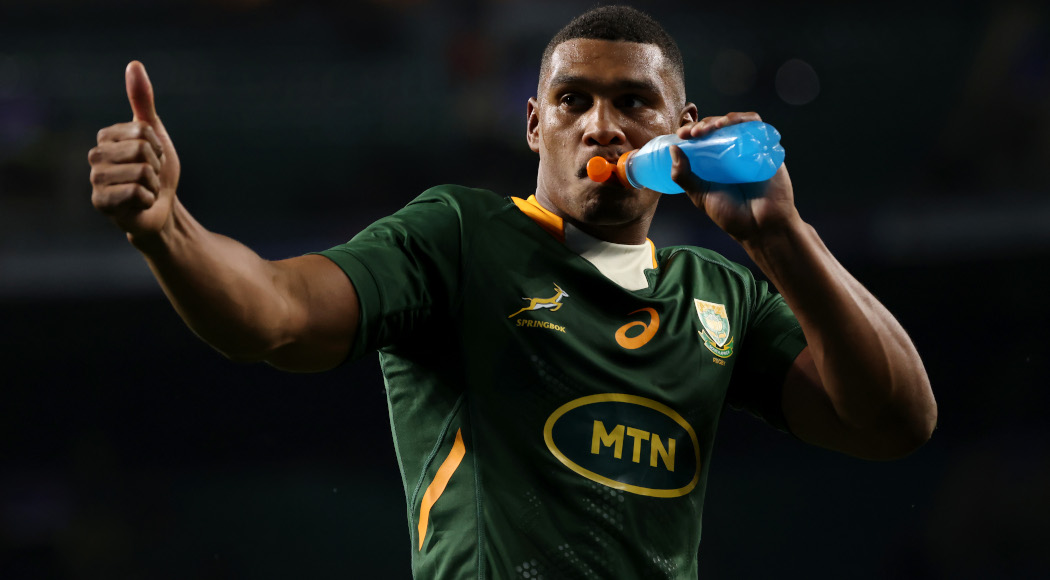
The Springboks have grown their depth enough during the course of 2022 to make the potential sleepless nights for the coaches at next year’s Rugby World Cup very different to what they were in Japan three years ago.
In the build-up to the 2019 triumph, one of the often-repeated questions as the Boks gathered momentum was “What happens if Pollard is injured?” Indeed, the thought of the Boks going into a World Cup play-off game without Handre Pollard wearing the No 10 on the back was too ghastly for those with South Africa at heart to think about.
The same questions were asked with Duane Vermeulen as the focus and also Pieter-Steph du Toit. In both instances those have now been obliterated by the emergence of in the first instance of Jasper Wiese and now Evan Roos, with the latter confirming his international potential at Twickenham, and in the second the continued good form and sheer omnipresence of Franco Mostert.
With Marvin Orie also confirming the strides he has made at international level in the England game, Mostert specialising as a No 7 is now far from the concern it might have been. Not forgetting of course that the Boks will be expecting both Du Toit back and available for his blindside flank role as well as the behemothic presence of Lood de Jager to be back by the time the World Cup arrives.
PROBLEM IS NO LONGER WHO TO PLAY, BUT WHO TO LEAVE OUT
The point being that suddenly any headache for the Bok coaches, in contrast to 2019, might now no longer revolve around who they’d have to turn to as cover for good players, but how they are going to select a starting team without having to leave out some really stellar performers.
On the face of it, that shouldn’t apply to flyhalf, for Pollard has played well over 50 games for his country, has won a World Cup for them and has now had two tastes of rugby’s global showpiece event. When he is at his best, he is a calm and collected controller of the game. There was something reassuring about the fact it was him who had to step up to kick the winning penalty in the World Cup semifinal against Wales on a Sunday night fraught with tension in Yokohama.
PLAN WITH WILLEMSE WASN’T TO MAKE HIM FIRST CHOICE
Pollard has had his off-days, as everyone does at some point - even Owen Farrell on this past weekend’s evidence - but Pollard is a recognised frontline place-kicker, as is his usual understudy in the national team, Elton Jantjies. Speaking of Jantjies, he’s had his off-field problems this year, and wasn’t helped when he did play by his lack of action at club level, but if he can sort out those things by the World Cup, his international experience should also still see him in the mix as one of the two specialist flyhalves at next year’s World Cup.
But there’s that word - specialist. Damian Willemse isn’t a specialist flyhalf, and the reason Nienaber stuck with him at No 10 for all the games on this tour wasn’t because he wanted the Stormers player to establish himself as the first choice, but because he wanted to develop him as a man who could be the back-up flyhalf in the squad.
Here though is the potential quandary that Nienaber will face next year - Willemse almost did too well at Twickenham, and for that matter in the games before that in Marseille and Genoa, in being a galvanising influence on the switch to a more balanced approach from the Boks. And by balance we are referring to the way they’ve transformed from being a team based around forward play and box-kicking to a side that can score the sort of try Kurt-Lee Arendse rounded off at Twickenham.
And which can score the several great backline tries that were completed in the rout of Italy the week before, and which can mount the kind of attacks and counter-attacks that appeared to stun the French at times in Marseille before that.
WILLIE HAS BECOME TOO IMPORTANT
If the veteran Willie le Roux was still struggling as he does sometimes at fullback we’d say “Okay, Damian can just return to fullback when Pollard returns”. But Le Roux is a crucial part of the Bok ability to mix up their game, with his dovetailing with Willemse as first receiver being a big part of the new dynamic the Boks have to their game.
Would Pollard have the same impact as an attacking player? It may well be that Willemse, who earns his bread and butter at the Stormers, where players are encouraged to be adventurous in approach, has moved far ahead of Pollard as an attacking player. Not the Pollard we saw as a youngster who attacked the gainline and terrorised the All Blacks at Ellis Park in 2014, but the more conservative Pollard of later vintage.
Does Pollard have the appetite for an attacking game and an appetite to be the X-factor presence that Willemse is? You’d have to ask him, but last year during the British and Irish Lions series his vigorous defence of conservative, one dimensional rugby - “It is what we love doing,” was what he said - suggests he might not.
Jantjies in fact is the less traditional South African flyhalf than Pollard is these days, but it is Willemse that has taken it to the next level in Jantjies’ absence. Willemse is not the perfect flyhalf, he maybe doesn’t have the game controlling abilities that’d make you bank your house on him ahead of a World Cup final, and his lack of ambitextrousness with his kicking feet, means he is still too easily boxed in. Hence Le Roux’s importance when he wears the No 10. But then the World Cup is 11 months away. That means he has time to develop, and he’s developed a lot just in the last four weeks.
The obvious question though, and the reason that Nienaber and national director of rugby Rassie Erasmus face a potential quandary, is what selecting Willemse at flyhalf would mean to the goalkicking department that becomes even more important in a World Cup. A World Cup play-off game is normally a tense affair and it is played out as such, with the importance of the kicking for posts role being ratcheted up in those games. The Boks scored two good tries in the 2019 final, but only after England had been sapped of energy by the Bok forwards and allround physicality.
IF DUBLIN WAS A PLAY-OFF GAME BOKS WOULD BE OUT
Faf de Klerk and Cheslin Kolbe, and even Willemse with his one attempt in Marseille, have been okay subsequently, but had the Ireland game in Dublin been a World Cup play-off clash, the Boks would have been bundled out of the tournament and goalkicking would have been to blame.
Pollard has kicked the clinch penalty in a World Cup semifinal and experienced the unbearable tension of a World Cup final and prevailed. So, it’s hard to see him being sidelined. But Willemse’s role in unlocking the Bok attacking game in recent weeks does introduce a potential dilemma. It is one which would be solved if Nienaber perhaps played Manie Libbok, who has become a metronome when it comes to place-kicking thanks to his relationship with Stormers kicking coach Gareth Wright, at No 10, and Willemse at 12.
But then before you even get to the question of what then happens to Damian de Allende, who can’t be accommodated at outside centre if Lukhanyo Am is back, you have to remember Libbok has only three test caps. It is unlikely Nienaber would back that inexperience in a World Cup.
Ultimately though it is a good dilemma for Nienaber to have, and is a far better problem to have than the “If Polly goes we are all doomed” scenario that Erasmus faced when he was head coach at the 2019 tournament.