

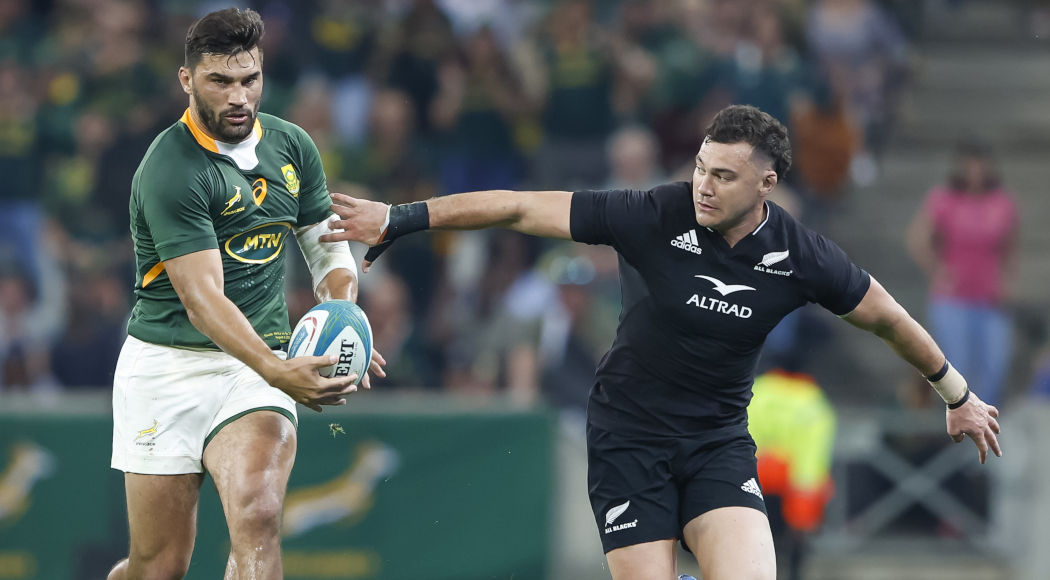
Damian de Allende gave quite a long-winded answer - a bit like this column - to a question from a New Zealand journalist on why so much had changed for the Springboks since 2017. What he said could have been paraphrased as “We had a change in coach”.

Regardless of what happens in the Emirates Airlines Park test, New Zealand rugby is at a crossroads. That the situation they are in is rescuable if they look at both some of the All Black history and the recent Bok history.
The Boks are probably the best example right now of why it is possible to say that not all is lost for the All Blacks if they harbour hopes of clinching a fourth Rugby World Cup title in France next year.
The 57-0 defeat they suffered in Albany, which followed on from a shattering 57-15 defeat to the All Blacks in Durban at the end of the previous season, was far worse than anything the Kiwis have had to go through. In many ways, the severe reaction to their current losing streak is an indicative of how consistently strong the All Blacks have been. They are being judged on All Black standards.
But the Boks were at a much lower ebb after that Albany defeat in 2017, with the brand being severely dented and rugby in this country considered to be in crisis. They managed to turn it around and it was under two and a half years later that the Bok team, featuring many of the same players that lived through the Albany humiliation, won the country its third World Cup.
That was also just 18 months after Rassie Erasmus took over from Allister Coetzee as head coach. We are now 14 months away from the next World Cup. The Kiwis do have time. The World Cup is a weird competition as all it really requires you to do is win a clutch of big games, it is not a long, drawn-out campaign and much depends just on what happens on the day.
However, it is important to note that it did take a change of coach, and the honesty and directness that De Allende referred to in his response to the media question, to turn it around.
SIR GRAHAM SET A GOOD EXAMPLE TO FOLLOW
Can the All Blacks turn it around without changing their coach? Well the experience of the last time they lost more than one game in a row to the Boks, 2009, suggests that it can be done. But it depends whether the incumbent coach recognises where it's going wrong for his team and does what is needed to turn fortunes around.
After the 3-0 whitewash suffered against the Boks in the 2009 Tri-Nations, the All Black coach Graham Henry, now Sir Graham Henry, absorbed several lessons, among them what he picked up as the Bok motivation when he visited the opposition the last match in Hamilton.
He directed the franchise coaches in New Zealand to pay particular attention to the areas of the game his team had fallen short against the Boks. In no time at all the field kicking game and lineout play of the Kiwi franchise teams had improved and the All Blacks went on to win the World Cup two years later.
It is not clear at this point whether Ian Foster will be as honest as Henry was. He seems to be in denial. Every utterance he makes in a press conference comes across as an exercise in denial, or deflection (reference the focus on the Kurt-Lee Arendse incident last week). The All Blacks aren’t going to turn anything around any time soon unless they face the facts.
A JOBURG WIN WILL REQUIRE GOOD COACHING
The problem for the All Blacks at Mbombela Stadium last week wasn’t just that they lost, but that they seemed clueless when it came to handling some aspects of the Bok game, such as the contestable kicking and rush defence.
The All Blacks can win against the Boks in Johannesburg, but it is going to require very clever coaching, and much more than was delivered last week. For the Kiwis can probably expect to be on the back foot at forward again. And the Bok defence is too good these days to leak a spate of tries like Ireland did in losing the first test in Auckland six weeks ago, which is the last time the All Blacks won a game.
INTERNECINE RIVALRY AMONG BIRDS
It was hard to stay focussed on a press conference session with Springbok players Kwagga Smith and Makazole Mapimpi this week. All week the sessions were held outside in the pool area of the Montecasino hotel where the Boks are staying in the buildup to Saturday’s test match.
Behind the advertising board that serves as a back-drop to the players it is very leafy and there hasn’t been any audio I have gone through afterwards that hasn’t featured at least one bird chirping in the background.
However, when Smith and Mapimpi went in front of the media in midweek, the mynahs in the tree behind them decided to take it a step further. They had a fight. Maybe it was the moment for them to battle for territory like the lions do in Kruger National Park. The players might have been oblivious to it, though hard to see how given the cacophony that accompanied the birds bundling all over each other as they fell from the tree and continued their face off in mid-air.
Press conferences can sometimes be tedious, I am sure often even more so for the players than the journalists who attend them, so it was a funny little interlude that made me completely forget what either Mapimpi or Smith said.
Those who are old enough to remember how the late great and colourfully wordy cricket commentator Charles Fortune used to bring Mynah birds into his broadcasts will understand what I mean when I say I wish Charles was there to describe that scene...
BOKS SELLING THE SPORT
This is my first visit to Joburg in a while and it is hard to escape how prominent the Boks are in being the national sport team that is most prolifically used for marketing purposes. Driving down the M1 from my hotel before linking onto the N1 and the William Nicol offramp, it feels like there is a poster featuring the Boks almost every two kilometres.
We don’t get that many roadside billboards in the less commercially orientated cities, so for this visitor from Cape Town it has been a bit of an eye-opener. The Bok success of the last few years has made the players hot property. Everywhere, but it seems particularly in the Big Smoke.
KOLISI IS ALSO MR POPULARITY
The Bok skipper Siya Kolisi has been particularly busy being used as a marketing tool since the World Cup, but fears that he might be over-exposed were allayed when the players had their faces and details flashed on the big screen and their names called out by the stadium announcer at Mbombela. The loudest, most rousing welcome given by the crowd was for Kolisi.
He really does appear to be popular everywhere he goes, and he helps himself with that wide smile and the obvious joy with which he conducts every social interaction or public engagement.
CONCERNS ABOUT GUSTO OF ANTHEM SINGING MISPLACED
There was an article somewhere after the Cape Town test against Wales where the writer expressed his disgust that South African rugby crowds still appear, in his view, to sing the old national anthem with more gusto than Nkosi Sikeleli iAfrika.
So, when the anthems were sung at Mbombela last week I watched out for it and scanned the crowd. From my observation, it comes down to the different types of singing that are required. Nkosi Sikeleli is a hymn, so it is sung as such. Every fan at Mbombela right across the racial spectrum looked like they were singing iNkosi whole-heartedly and with great emotion, with many people having tears in their eyes. There was no doubting the passion and the patriotism.
When the Call of South Africa part was reached, the singing did get louder, but then it is that kind of song. You shout it rather than sing it. That’s all it comes down to, nothing sinister at all.
Complaining about the different loudness of the various parts of the anthem is a bit like having a go at Bono, if he had a baby sitting on his lap and he was trying to sing it to sleep, not putting the same loudness and gusto into that performance as he does when he sings Sunday Bloody Sunday!
LAST WORD ON NELSPRUIT
Goodness knows what is going to become of the Currie Cup, and maybe the old trophy might still end up in a museum, like Gert Smal suggested it should. But in the meantime, it is being put to good use in the lowveld, which of course is now Currie Cup country. More than one person I encountered last weekend told me they’d either had the Currie Cup trophy brought to their place of work or were going to have it visit the next week or week after.
What the Pumas did for rugby in their region by winning the Currie Cup should not be underestimated. For me, hearing about the good it has done for the sport in that region is all the more reason to hope that going forward the rugby bosses remove the URC franchise second string teams from the competition. Having the next best from those unions only cheapens it.
Rather have a 10-team competition featuring all the other unions playing for both the old trophy and the even bigger prize of featuring in the European Champions Cup the following season.
Taking that route may see country unions other than just the Pumas get the boost that Jimmy Stonehouse - who appeared to really entertain Nelspruit’s most famous son Duane Vermeulen with his singing at halftime last week - and company have done and are doing for the sport on the lowveld.