

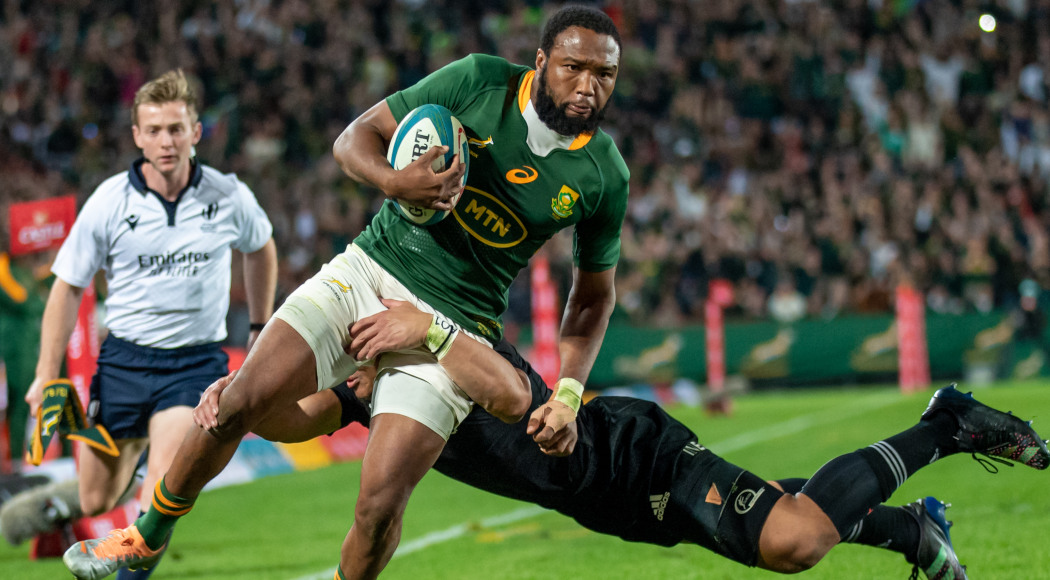
It is somewhat unusual for a Springbok back to be the talking point of world rugby. It is usually their forward play that sets the world champions apart from the rest. If there was an individual star who shone brighter than the rest this past weekend though, it was undeniably Lukhanyo Am.

“The most complete backline player in world rugby” was the way one overseas rugby website described Am’s contribution to his team’s ultimately vain comeback against New Zealand in Johannesburg in the return Castle Lager Rugby Championship clash. And that praise was deserved.
We saw Am’s brilliant running abilities and X-factor at their best in the Rugby World Cup final in Yokohama in 2019. If Duane Vermeulen hadn’t been as good as he was in helping the Bok forwards dominate England that day, Am would surely have walked away with the man of the match award.
He was good enough to be the man of the match at Emirates Airlines Park too, even though he was on the losing side. Apart from the try he scored where he beat three defenders before reaching out to do down in the corner to bring his team back into it shortly before halftime, Am was over the line again but had a try disallowed in the 13th minute.
But it was the way he seemed to dazzle the All Black defenders almost every time he got the ball in his retreaded position of right-wing, a position he was forced to switch to because of Jesse Kriel’s early injury, that had some of his old-timers thinking back to when last a Bok back shone so brightly on an individual basis.
From a personal viewpoint, although there have been some great centres and wings in the interim who have played for the Boks, the image that was conjured up every time Am swept and weaved his way through the opposing defensive system was of Danie Gerber, the legend of the 1980s. Gerber seemed to cut through opposition defensive systems at will, and that was what Am did in Johannesburg.
It was a huge pity for him that he didn’t end on the winning side as he would have been even more of a talking point had that been the case.
Given that the Boks lost this week, whereas the previous week they were comfortable winners, it should not be surprising that our Southern Hemisphere team of the week has a very different look to it this week, with the All Blacks standing up well from their disaster of the previous week. After not being at the races in Mbombela, the All Blacks were good enough to contribute seven players to the team of the week, with Argentina and South Africa providing the other representatives on a weekend where the Wallabies bombed.
Southern Hemisphere team from Week 2 of Rugby Championship
15. Jordie Barrett (New Zealand)
My co-selectors went for Willie le Roux here, doubtless because of the flash he brought to the Springbok attacking game when they were trying to make up the deficit created in the first half of the Emirates Airlines Park clash. And he was brilliant, with 14 completed passes and 52 metres gained with his running. But given the way the All Black back three responded to the Bok contestable kicking assault this week, and Barrett was pivotal to that, he cannot be overlooked.
14. Lukhanyo Am (South Africa)
You wouldn’t start him at wing, but given how he went as a replacement wing against the All Blacks, he was the first name written down on the team sheet. He scored a try where he got the ball with lots still to do shortly before halftime and was over the line for a disallowed try in the 13th minute. And 137 metres run pretty much explains why, just like Malcolm Marx the previous week, we’d have 15 Lukhanyo Ams in our team if only somehow he could find a way to jump in the lineout, throw the ball into the lineout, push in the scrums and kick from the tee…
13. Rieko Ioane (New Zealand)
Funnily enough, if we were really going to see this team play, and I had to coach them as well as be chief selector, I might interchange Ioane with Am. For he’s played a lot of rugby on the wing. But this is about the best player in each position on a particular weekend and that’s where Ioane troubled the Boks in Johannesburg.
12. David Havili (New Zealand)
A lot more worked for the All Blacks in Johannesburg in comparison with Nelspruit and the midfield, much criticised the previous week, was largely responsible for that. This was a day when passes stuck and possession was retained rather than spilt. Apart from rounding off what was effectively the match-winning try for his team, he was a creative presence and it was his cross-kick that set Ardie Savea off for his early run that nearly led to the All Blacks’ first try. The other contender here was Argentina’s Jeronimo de la Fuente, who scored a great try for the Pumas, while on the evidence of what he did in the midfield as a replacement, Damian Willemse could grab our No 12 shirt if he ever starts there for the Boks.
11. Makazole Mapimpi (South Africa)
This was a toss-up between the Bok World Cup-winning wing and the Los Pumas’ Emiliano Boffelli, who was outstanding in both matches his team played against Australia. However, Boffelli was on the right wing, and we don’t need him for his kicking as the two flyhalves in contention, Richie Mo’unga and Handre Pollard, were outstanding off the tee last weekend. Mapimpi crossed the line twice, once disallowed, and showed off his renowned finishing ability. Like Am, it is a pity that he doesn’t get the ball off a full-line movement in other matches as regularly as he did in Johannesburg.
10. Richie Mo’unga (New Zealand)
If the All Blacks got a big answer or solution to a problem out of the Johannesburg game, it was the impact made by Mo’unga as the starting flyhalf. He brought better structure to the All Black game and was instrumental in reversing the territorial deficit the Kiwis suffered in that battle at Mbombela. South Africa’s Handre Pollard would be second choice purely on his immaculate place-kicking display, while Santiago Carreras is growing as the Argentina No 10.
9. Gonzalo Bertranou (Argentina)
The Los Pumas scrumhalf was probably his team’s most important player in their surprisingly big win over the Wallabies in San Juan. He was powerful around the fringes and his kicking game was also exemplary. The same could probably be said about Aaron Smith for the All Blacks. The Highlander definitely had his zip back but Bertranou gets the nod on the basis that he was perhaps marginally more instrumental in setting up the result.
8. Ardie Savea (New Zealand)
This was the second successive week he made the team but there was less debate over his selection this time. He almost turned in the kind of performance Malcolm Marx did for South Africa the previous week, proving a menace to the Boks at the breakdown. Time and again when a Bok attack was held up, it was Savea who was the source of it. Apart from that, he also made 51 metres from 13 carries.
7. Pieter-Steph du Toit (South Africa)
The good news for the Springboks ahead of their two matches in Australia is that the 2019 World Rugby Player of the Year is gaining momentum and starting to look like the world-class player he is after a slow return to international rugby after almost a year away nursing injury. Du Toit’s intercept and charge upfield broke the early All Black shackles and nearly led to an against-the-run-of-play try. It is his work rate that is so impressive and he was a big part of the dominance the Boks started to get in the middle stages of the game.
6. Juan Martin Gonzalez (Argentina)
We went for Siya Kolisi last week on the basis of him captaining the Boks to their fine win in Mbombela, so by rights, we should really be giving Sam Cane the job of leading this side after his excellent leadership at Emirates Airlines Park. But the inspirational Argentina opensider Gonzalez was just exceptional in San Juan so we had to include him in what looks a well-balanced and menacing back row.
5. Tomas Lavanini (Argentina)
I ignored my co-selectors last week and went for Lood de Jager over Lavanini so following another excellent showing from the Pumas No 5, his claim is hard to ignore. Like De Jager, he is powerful when he carries the ball, and that is in addition to his solid lineout presence. The man he beat this week was the All Blacks’ Scott Barrett, who turned in perhaps his best performance in the black jersey in Johannesburg. Barrett’s carries were part of the reason the All Blacks looked a lot toothier than they did on the lowveld.
4. Sam Whitelock (New Zealand)
Okay, so I said last week that Eben Etzebeth would make it every week, but then that was operating on the assumption the Boks would win every week. They didn’t in Johannesburg, and Whitelock answered his growing legion of critics with a solid lineout performance that played a big role in ensuring the Boks didn’t get the platform they were seeking, particularly in the first half. Apart from poaching a few Bok balls in the lineout, Whitelock was also a thorn in their side when they tried to carry the ball as he made seven tackles.
3. Fletcher Newell (New Zealand)
The All Black scrum stood up well to the much-vaunted Bok unit and they were particularly good later in the game, once Newell came on for the equally impressive Tyrel Lomax.
2. Malcolm Marx (South Africa)
He didn’t make the impact at the breakdowns when he came on in Johannesburg, and may not have been at full gallop, but Marx was again a huge presence as a ball carrier in a period of the game where the Boks really looked like they had done enough in coming back to secure the win. Julian Montoya of Argentina and the All Black hooker Samisoni Taukei were both good enough to secure the hooker spot but let’s do something the Boks didn’t do when it came to selection for this position and go for continuity.
1. Thomas Gallo (Argentina)
In the first week of the Championship, the Pumas forwards were guilty of giving it away in the last quarter, but they didn’t in San Juan, and the all-around game of Gallo was a big part of the reason they swept the Wallabies away. Apart from his solid scrum work, Gallo carried well and also made 11 tackles. Steven Kitshoff was the next best loosehead in the second round of competition.