

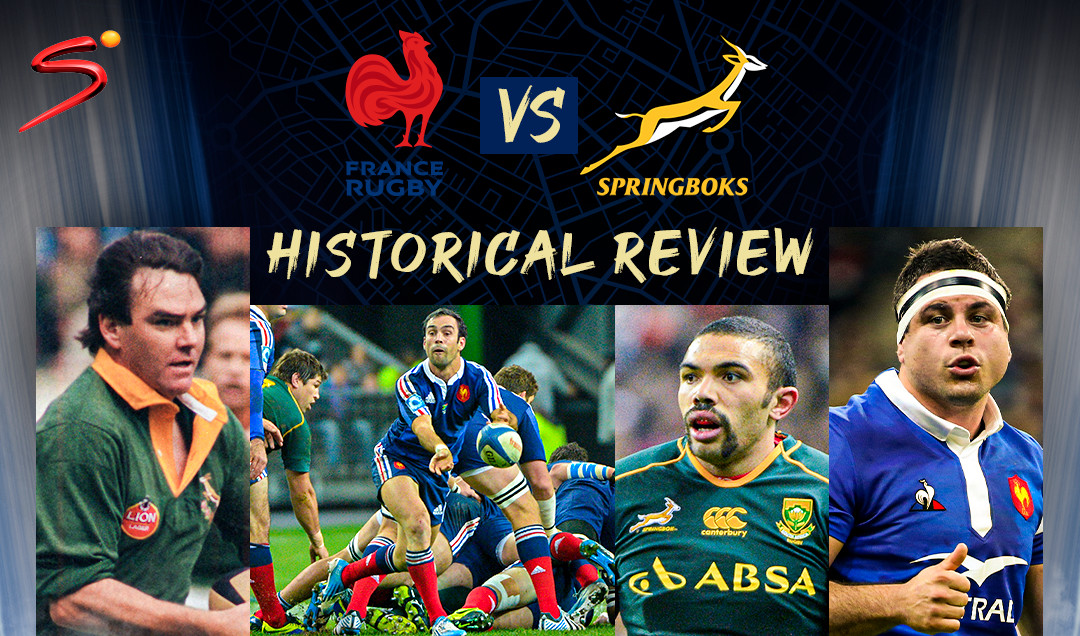
There has only been one test match played between France and South Africa at the Stade Velodrome in Marseille, but the Mediterranean city as a whole has hosted some interesting times and there has been plenty of gravitas attached to the venue for the Springboks since 1992.
To get to that one international match first, it wasn’t a night to remember for any South Africans, with the possible exception of Pieter de Villiers, the prop from the Cape West Coast who played for France in those years and is currently an assistant coach at Scotland.
For two legends of the South African game, Jean de Villiers and Bakkies Botha, that balmy night in Marseille on 9 November 2002, meaning exactly 20 years ago at the time of writing, was memorable for all the wrong reasons.
For De Villiers, it was the night he made his Bok debut after having played just one Currie Cup game for Western Province. He was still just 21 and was selected on what he’d done at age-group level. The Bok coach of that time, Rudolf Straeuli, was much maligned, but you have to give him credit as a talent spotter, for in his time he did blood several of the players who were later to win a World Cup under Jake White.
But maybe De Villiers was pushed too early. Within minutes of the game starting, he was lying prostate on the Stade Velodrome turf before being stretchered off with a serious injury that kept him out for much of the World Cup year that followed. He came back shortly before that World Cup only to get injured again. Fighting his way back from injury, and then being unlucky with that at World Cups, was to become a theme of De Villiers’ career, with the trend starting that night in Marseille.
The big enforcer, Botha, had better luck through his career than De Villiers, and became as legendary as the centre. You may not have expected that in that Marseille game though, as Botha, also playing his debut game at a callow age, was one of several Bok ships that slipped down a precipitous path into the nearby Mediterranean and sank without trace.
After his nondescript and ignominious debut, Botha struggled to re-establish himself as a Bok contender until White arrived in the national coaching position in 2004. Not that he was the only player to misfire for the Boks on their only previous appearance in Marseille against France, the entire team struggled.
GREAT AREA TO VISIT
Not that it was a struggle for those of us covering that tour to enjoy Marseille, or more accurately, that part of the French coastline. The Boks were accommodated at a luxurious golf estate near Bandol, on the south-eastern French Riviera, probably about 60 kilometres outside of Marseille, and although it wasn’t holiday season the week spent in that village was a memorable one.
Marseille itself is an interesting city, and my first visit there, and the Boks’ first visit in the modern era, was in 1992, on the first post-isolation tour. The Boks and media were accommodated in a hotel right on the sea, as in on the rocky shore, and after some of the hotels they’d put up with earlier in a tour where the lack of exposure to the realities of touring left the Bok management well short, it was like being in paradise.
It also gave some of the players time to reflect on the tour itself. Up to that point, the Boks had been put up by the French in hotels in industrial areas or out near the airports of the cities and towns where they played. And they were also suffering because of the energetic hospitality intent of their hosts, who insisted that they attend lavish receptions in every venue they visited. Remember, the Boks hadn’t been in France at that point for nearly 20 years.
“If I see another prawn, I might puke,” said Hugh Reece-Edwards as I encountered him and fellow Natal teammate Steve Atherton enjoying the sunset in the days building up to the game against the local provincial team, Langedouc-Roussilon.
Atherton, a lock, was to become a talking point after that game, a fixture that drew the Bok players, who in those days were split by the internecine rivalry that is an inevitable consequence of such long isolation, properly together for the first time.
What galvanised the Boks that night, and I remember this clearly, was their involvement in, and hands down victory, in a mass brawl that broke out early in the game. The broad shouldered and imposing Atherton was in the forefront, effectively the team leader in the fight, as he slugged it out with his opponents in front of a hostile and noisy crowd.
The Boks went on to win that game comfortably and while the rest of the tour was still a struggle, most of the players who were on it will vouch that things got easier for them after that and the team became more together. There is no more sure way of bringing South Africans together than to get them to team up for a proper fight.
The players, Reece-Edwards included, will also tell you that Atherton, who previously had appeared hardly known to the Bok coach of the time, Professor John Williams, suddenly became the Bok mentor’s personal pet after that.
“It was all ‘Steve this, hey Steve, can I do anything for you’, after that,” recalled Reece-Edwards in a book I wrote that featured that period of Bok history.
FOUR MORE YEARS GUYS, FOUR MORE YEARS
The Boks’ other visit to Marseille was in 2007, during the Rugby World Cup that they went on to win. They played Fiji in the quarterfinal at Stade Velodrome on the Sunday after England had knocked out the more favoured Australian team at the same venue the day before, and John Smit’s team nearly suffered the same fate as they produced a nervy performance in their first knock-out game.
What was memorable about that trip was what happened the night before the game. I was staying in a hotel on the Marseille harbour front, where there was a special World Cup concert, featuring KT Tunstall among others. My hotel room was effectively in the concert venue, so there was no chance of sleep after working on the England/Wallaby quarterfinal that afternoon, but then who needed to sleep for there was something else that happened that grabbed everyone's attention.
It was the night the All Blacks were knocked out of the World Cup by the hosts in Cardiff, and with Australia also out and France not really in great form, and neither were England, it meant the Boks were suddenly outright favourites to win their second Webb Ellis Cup. Hence the nerves against Fiji the following day.
My own reaction to the final whistle that signified the end of the All Black challenge wasn’t very neutral or unpartisan: I remembered what Wallaby captain George Gregan had chided the New Zealanders with when they were headed for defeat in their semifinal in the previous World Cup four years before that - “Four more years guys, four more years”.
So down the streets of Marseille I ran, as it appeared all the French people were also doing, and bellowed at the top of my lungs “Four more years guys, four more years”. World Cups can bring strange things out of people.
As an aside, the All Black coach in that previous World Cup in 2003, John Mitchell, told me when I was helping him write his book 'Mitch: The Real Story', that it was when the final whistle blew in that 2007 quarterfinal that he was finally released from his own purgatory following four years of living with being blamed for the All Black exit from the previous World Cup.
World Cups don’t just bring strange things out on people, they also are taken really seriously, perhaps too seriously, by nations and the people of those nations.
GOOD TIMES IN FRANCE
Most of the Bok test matches on French soil in the post-isolation era have been played in Paris, although it was in Lyon that they won the first test of the two-game 1992 series, and their record 52-10 win in the last game to be played at the old French headquarters of Parc des Princes in 1997 was preceded by a 36-32 win in Lyon. That game, Nick Mallett’s second in charge, was not as close as that scoreline might suggest - the Boks had won it comfortably before a late French flurry towards the end.
That record win in 1997 was a special moment for Bok rugby and those who were there won’t forget the tumultuous party in the James Joyce pub next to the Bok team hotel in Paris in those years, the Concorde Lafayette, that went long into the night and featured a few people of my ken, who shall remain nameless at this point, dispensing with their clothes during the singalong.
The last time the Boks played against the French outside of Paris was also the last time they lost to France in France - that was the Toulouse game in November 2009, a match which might be remembered by many South African fans for the mess the singer made of the South African anthem beforehand. He turned it into a reggae song, which did not help a Bok team that tends to treat the anthem as the same important motivating force that the All Blacks do the haka.
The Boks are currently on a seven-game winning streak against France that started with their win in Cape Town in 2010, although the last two games, both at Stade de France, were close, with the Boks edging home by one point in Allister Coetzee’s last tour in charge before winning off the last move of the game in the current coaching group’s only clash with the French in 2018.
In all, the Boks have won 27 of the 44 games played between the two nations, with 11 defeats and six draws. That is not something then that should trouble Siya Kolisi and his men - what maybe should trouble them is France’s excellent record in Marseille and their rise up the world rankings during an 11-game winning streak that should make them slight favourites for Saturday.
Springbok v France in France since end of isolation:
1992: France 15 SA 20 (Lyon)
France 29 SA 16 (Paris, Parc des Princes)
1996: France 12 SA 22 (Bordeaux)
France 12 SA 13 (Paris, Parc des Princes)
1997: France 32 SA 36 (Lyon)
France 10 SA 52 (Paris, Parc des Princes)
2001: France 20 SA 10 (Paris, Stade de France)
2002: France 30 SA 10 (Marseille)
2005: France 26 SA 20 (Paris, Stade de France)
2009: France 20 SA 13 (Toulouse)
2013: France 10 SA 19 (Paris, Stade de France)
2017: France 17 SA 18 (Paris, Stade de France)
2018: France 26 SA 29 (Paris, Stqade de France)