

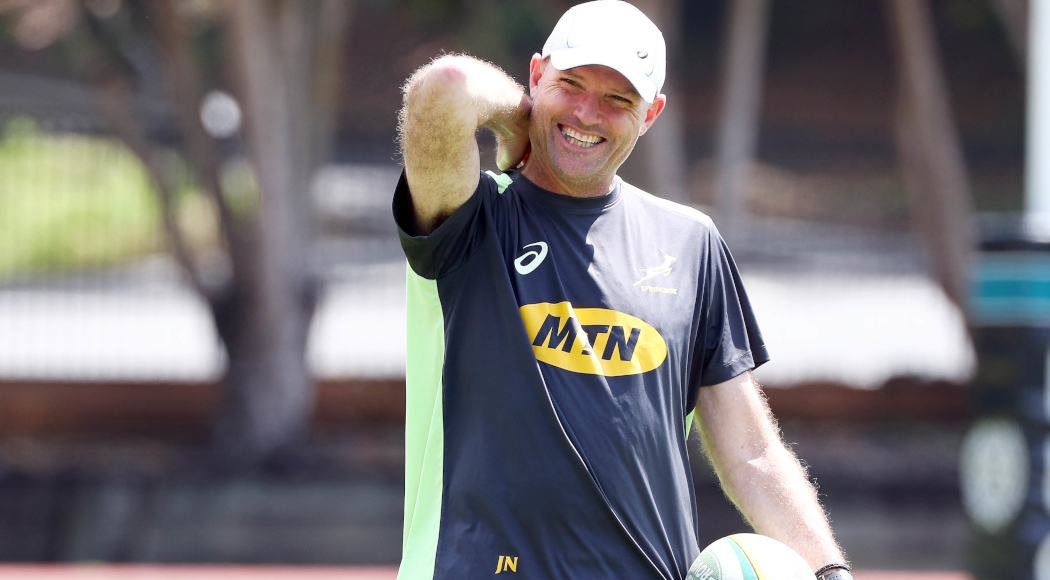
Coach Jacques Nienaber believes the lag that the Springboks picked up due to missing out a year during the current World Cup cycle was made up quite well in 2022, particularly in the latter part of the penultimate season before the next global showpiece event in France.
Speaking at a media session during a break in the alignment camp being held in Cape Town on Wednesday, Nienaber said that while for the previous two years following the 2019 RWC triumph in Yokohama there were various reasons why the Boks were lagging in their development, it all started to come together on the end of year tour.
And it was unsurprising that when referring to the depth coming through in various positions, flyhalf was the one he referenced.
“This time last year a big topic we were speaking about was flyhalf and who we had to fill that role,” said Nienaber.
“As it turned out, due to injuries, such as Handre (Pollard) being out early on, we were forced to go different routes and in the end it turned out well for us. We are now comfortable with Damian (Willemse) playing flyhalf should it be necessary, we also know Frans Steyn can play there.
“We actually have quite good depth in that position in comparison to other countries. If any country goes down to their third choice flyhalf, there is a drop in quality. You are very lucky if it is not like that. We are fortunate in that we have some quality No10s available for selection.”
GROWING THE TEAM’S GAME
DHL Stormers pivot Manie Libbok got three playing opportunities off the bench on the end of year tour and he would have been one of the flyhalves Nienaber would have been referring to.
Which cues the other aspect of growth that might even exceed depth in playing personnel in level of importance - the development of the team’s game.
It is often forgotten that the Springboks have been at a disadvantage for much of the current four-year cycle. They were the only top nation not to play any rugby in the first Covid year, 2020, and that meant they missed a year of the team’s development and growth.
Of course, there is a reason why it was easy to forget. The Boks went virtually straight from the World Cup final in Yokohama in November 2019 into the British and Irish Lions series in July 2021.
The only test match they played in the intervening period was the one warm-up game ahead of the Lions series against Georgia.
They did play a game as the South African A side, which was a Bok team in all but name, against the Lions about 10 days before the official start of the series. But otherwise they went in cold. And won the series.
You don’t play no rugby together and expect to beat the Lions, so the positive result, achieved with a game plan identical to that which secured the Webb Ellis trophy, obscured the lack of growth in the Bok playing template.
The decision to stick with what worked in Japan was directed by necessity.
DECISION WAS RIGHT ONE BUT IT COST THE BOKS DEVELOPMENT
Nienaber has often mentioned the lag that was created by the loss of the 2020 season.
He’s never hidden from the fact that the decision not to play that year did cost his team and it was hard to bring in any new dynamics to the Bok playing style in the 2021 season, which was dominated by the need to win the iconic series against the British and Irish tourists.
Much of that international season saw the Boks having to confront massive obstacles placed in their path by Covid, such as the two week isolation forced on them by quarantine protocols at the start of the Australian leg of the Castle Lager Rugby Championship. Four of the six Bok games in the competition were played on Australian soil in 2021.
“The decision not to play in 2020 was directed by three things,” says Nienaber. “We had to ask if it was going to be good for us financially, and it wasn’t, and neither was it going to be beneficial to our development after the World Cup to play in the circumstances we would have faced had we played that year.
“Linked to that, was it good for player welfare for us to play, given that our country had one of the hardest lockdowns during Covid and our players were confined to their home for a couple of months. The answer there was also no. For us not to play for those months was the right decision, it was 100 percent the right decision. But it did cost us development.”
GROWTH STARTED TO ACCELERATE IN THE LATTER PART OF 2022
The win-at-all-costs nature of 2021 didn’t give Nienaber much opportunity to blood new players, but that changed in 2022. And as the season moved on, the Boks also started to add to their game.
By the end of the year, they were looking a much more adventurous and creative force than they had previously, and were unlucky not to beat the top two teams in the world, Ireland and France, on a tour where they comprehensively outplayed both England and Italy.
“Last year was big for us in regard to our game coming through, particularly towards the back end of the season. From a creative point of view we must make sure we stay creative otherwise other teams catch up. It would be really arrogant of us to think we can go the World Cup in France and think that we can win again with the same playing style that worked in Japan.
“But it was always going to take time. If you want change, that change has to start happening on the training field first. There you don’t have the pressure of winning and losing. And then you move it to the test match environment where there is the big pressure attached to winning and losing.
“It is not just physical development but mental development that is required. It may sound like an odd thing to say, but failure is also part of evolving and developing. No one goes out and learns to ride a bike by just riding perfectly the first time, you will fall off a few times.”
GROWING DEPTH DOES NECESSITATE RISK TAKING
Nienaber said that the process of spreading the net so that he had a good reservoir of players capable of playing the game he was developing also required risks.
Such as when he made wholesale changes for the second test of the three game series against Wales in Bloemfontein.
“If you as a national coach just go and bat for your own win percentage every time you play, then guys won’t come through,” said Nienaber.
“Why would I make 18 changes from one test match to another? Everyone said I should secure the series first, but squad development was a big driver for us last year. You do still have to play to win, so we had development considerations on one side and the need to pick up momentum and therefore confidence by winning on the other. I thought we had a few nice changes coming through by the end of the season.”