

The Springbok brains trust may have watched the opening round of the Guinness Six Nations with mixed feelings - while France delivered a statement performance and England continued to confirm their rising challenge to South Africa’s global hegemony, there was also the continued demise of Ireland as a credible threat.

Referring to Ireland as demised may seem a bit over the top, and perhaps a bit precipitate too to those who remember how the Irish bounced back to disprove the critics who were circling after Loftus in July 2024 by beating the Boks with a last gasp drop-goal in Durban a week later.
No-one saw that coming at the time and there was much chest beating among the supporters of the team representing the Emerald Isle.
That was just 19 months ago and at the time there was reason for the Irish to still be upbeat.
Yes, they’d failed to make it beyond the quarterfinal stage of the Rugby World Cup in France due to arguably the best performance New Zealand have produced since 2018, but they’d gone on after that World Cup to annex a second successive Six Nations title and were only just denied an unprecedented second successive Grand Slam by a narrow defeat at the hands of a highly motivated and passionate England at Twickenham.
A YEAR AND A HALF IS A LIFETIME IN RUGBY
There was no denying that Ireland was still one of the world’s top teams, and the World Rugby rankings said as much. But if a week is a long time in rugby then a year and a half is a lifetime, and that was then and this is now.
‘Now’ in the Irish rugby context is a landscape that, since that heady day in Durban, has seen them lose twice more to New Zealand, get thrashed by France in Dublin at the start of last year’s Six Nations, get physically bossed by South Africa in Dublin in what was probably their most embarrassing capitulation of all. And then it was France who last Thursday made it two in a row in big wins over the team they replaced as Six Nations champions.
This edition of the Six Nations has only just begun, and there were mitigating factors at the Stade de France. Among the several Irish players out were the experienced props David Porter and Tadgh Furlong, the abrasive centre Bundee Aki, fullback Hugo Keenan and Mack Hansen who’d all normally be certain starters and were British and Irish Lions last year, plus Ryan Baird.
TRANSITION PHASE IS UNAVOIDABLE
Talking of the Lions, perhaps we shouldn’t underestimate the Ireland coach Andy Farrell either, or misunderstand what he is busy with after he effectively took a year’s sabbatical from his day job role. It would be understandable if pre-Lions series Farrell’s focus was deflected, and that he now knows he has some catching up to do.
There does need to be a period of transition with Ireland, and many of those aforementioned players who were missing are old. Ireland doesn’t have the abundance of talent that South Africa does that has made it possible for Rassie Erasmus to rotate and keep winning.
What has alarmed Irish rugby people almost as much as the Paris result was the more than 50 points conceded by an Ireland XV, effectively the Irish ‘B’ team, to England A the next day. But when Farrell left out James Lowe, such an integral part of the successful Ireland period from 2022 to 2024, he was picking on form and also acknowledging the need for change.
Perhaps the pain that Ireland are enduring now will turn out not to be in vain, with the next World Cup still more than a year and a half away. Yes, we are at the halfway point now between their Durban win and the start of RWC 2027, and if they can fall away so alarmingly over that time period maybe they can arrest it in the same period of time.
Erasmus and Jacques Nienaber did that with the Boks between 2018 and 2019, with many of the same players featuring under that duo that had been part of the Coetzee team that failed.
BOK MAULING WAS ARGUABLY THE REAL BUBBLE BURSTING MOMENT
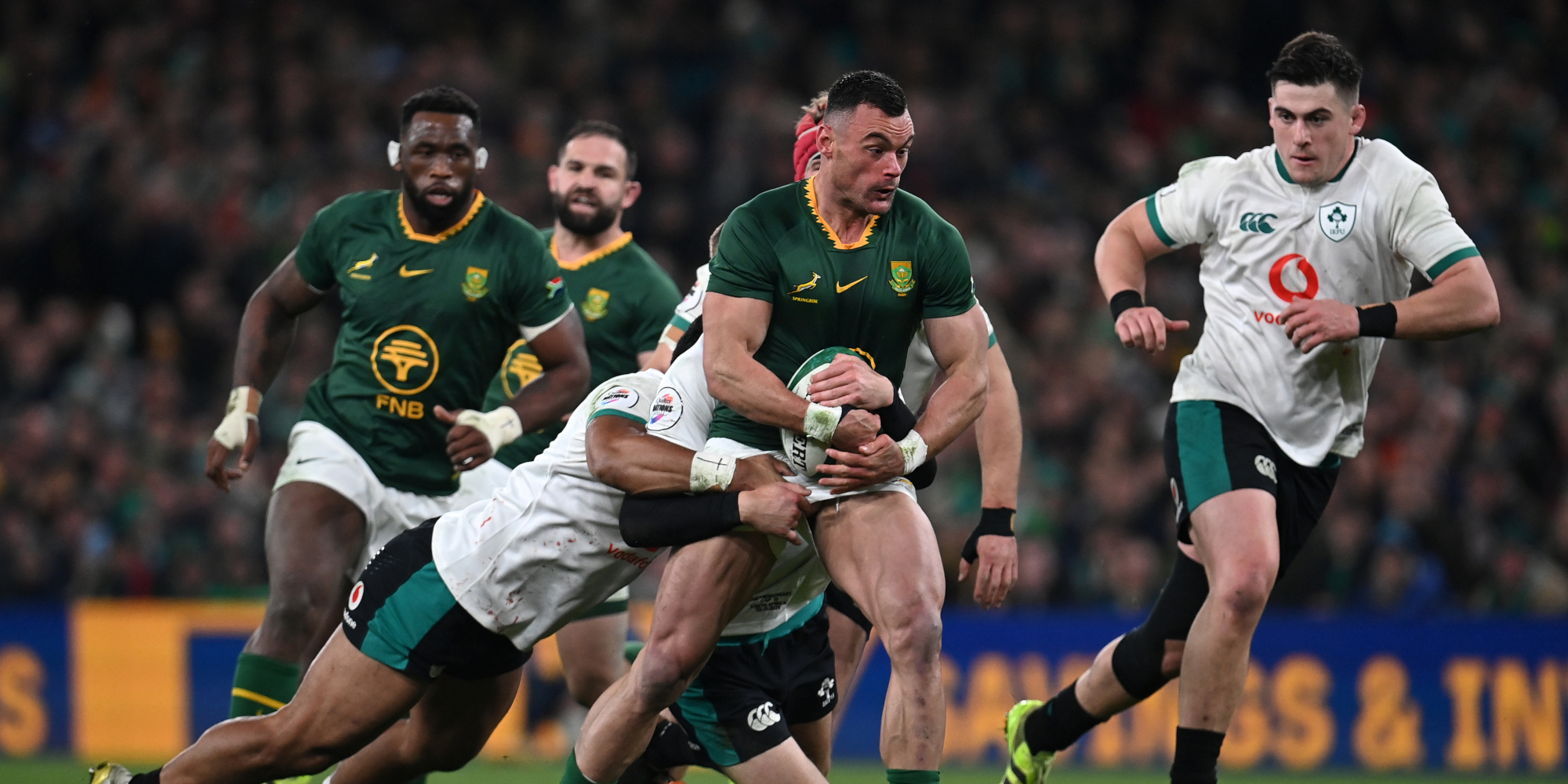
But the Irish psyche has been bruised, with the French win coming in the next game after Ireland had arguably hit the moment when their bubble was really well and truly burst - that being in the physical mauling at the hands of Erasmus’ Boks at AVIVA Stadium in November.
Before that it did feel like Ireland might be okay, that their loss to the All Blacks in Chicago, where the Kiwis only really properly wrapped it up in the last quarter, was just a blip and they’d bounce back. But it was the manner in which the Boks completely outmuscled a team that had shocked them with their physicality in Durban in the previous meeting between the two teams that tipped the Irish over the edge.
For it almost felt like the score was irrelevant to the Boks that day, they just wanted to strangle Ireland - and they did.
As it turned out the latest France win wasn’t built around the scrumming dominance that many felt the Boks had shown them the way with, but by a great blend of power, finesse and dominance of the aerial battle.
FEARS THAT RUGBY’S EVOLUTION IS LEAVING IRELAND BEHIND
It is that last mentioned aspect that may sound a warning to Ireland that is almost as loud as that sounded by the Bok scrum just under three months ago.
For there is a feeling adrift among Ireland’s rugby cognoscenti that it might be the Ireland way that is being left behind as much as it is the inevitable cycle of players change and the inevitable questions about depth that always accompany that change.
Meaning that Joe Schmidt, who we will remember for scripting that excellent win over the Boks at the start of the Allister Coetzee era at Newlands in 2016 (it was 14 against 15 following the CJ Stander sending off for his dangerous tackle on Patrick Lambie), and he followed that up with a thumping win in Dublin 18 months later that effectively ended Coetzee’s reign, brought in a game that Ireland have thrived on but which has now become outdated.
Schmidt’s rugby was highly programmed, everything was scripted. It was the Irish level of organisation, and their ability to effect phase play at high tempo with minimal mistakes as the result of meticulous drilling and planning, that paved the way for their rise to No 1 in the world, a status they certainly deserved after their historic away series win in New Zealand in 2022.
Schmidt wasn’t there then of course, but Johnny Sexton was, and that provides room to suggest that it is both things working against Ireland now - both the changes to the game, with the box kicking emphasis taking the structure that Ireland thrived on out of the equation and teams like France scoring against them after creating chaos, and the cycle of players.
SEXTON PROVIDED THE LINK BETWEEN DIFFERENT COACHES
At this stage of his career Sam Prendergast is no Sexton, and neither are the other flyhalves that Ireland have tried. It is argued by some Irish critics that while Schmidt and Farrell, who succeeded him after the 2019 World Cup, are very different coaches, it was Sexton’s role as link between the eras as chief playmaker that allowed Farrell to continue to work off the programming base that Schmidt had built.
As by far the most dominant Irish province of the last decade and more, Leinster, who for a long time had former England coach Stuart Lancaster as their technical brain under the head coach Leo Cullen, also provided that link.
But since Lancaster left for first Racing 92 and now Connacht, that link has been broken, and the core of the Leinster team that perennially challenged for European glory and were serial winners of the URC in its former guise as the Guinness PRO14 has either retired (Sexton) or gotten old.
THERE WILL BE INTENSE FOCUS ON LEINSTER AFTER SIX NATIONS IS OVER
Leinster are a very important part of the Irish system and when this Six Nations is done and dusted, regardless of where Ireland end up there will be a lot of Irish focus on how Leinster perform and how their game develops for the rest of a current season where they started poorly because of the absence of their many Lions players.
Even since the Lions have returned Leinster haven’t been as dominant as they used to be, and there may be some validity in the theory that having so many Lions in Australia in July and August worked against them.
It might be a bit glib to accept the other theory, that replacing Lancaster as Leinster’s senior assistant with Bok World Cup coach Jacques Nienaber has led to a more defensive mindset and a move away from what made Leinster good before, is also part of the problem.
But the Irish have reached a point where all possibilities have to be examined and theorised for fear that Ireland might reach the next World Cup forced to aim much lower than they did in 2019 and 2023.
In Ireland’s place, England are rising again. But England are both the only northern hemisphere nation to win the World Cup (2003) and have also made the most appearances in the final (four), so they invariably are in the equation when potential winners are discussed a the start of a World Cup.
Continue their current decline and Ireland won’t be a team the other challengers will need to worry about.