


If you ever wonder what drives Rassie Erasmus to coach with the passion he has - it is simple: The fear of failure.

The fear of failure not in the classical sense, but rather the fear of disappointing South Africa, of disappointing a passionate public that hangs on every result when the Springboks play.
That’s the real fear.
Take a look at a photo of Erasmus when the Boks last met England in 2018, young, fresh-faced and confident, and take a look at him now. The coaching job has taken its toll, and while it happens to every Springbok coach, that ageing that the stress of one of the toughest sporting jobs in the world does to you, Erasmus is still going strong, and still able to find the passion to do it.
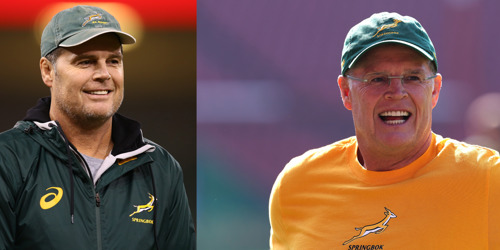
Two World Cups behind him and a year or so away from an attempt at making history with a third consecutive tournament. Springbok rugby is in a very healthy state, and Erasmus is driving it harder than ever.
So what is it that drives him? What keeps that fire burning for him to keep on believing, keep on fighting to keep the Springboks at the top of World Rugby?
It’s simple. That fear of failure.
TAKES LOSSES HARDER THAN PEOPLE THINK
Erasmus answered candidly this week when I put it to him. It is something that he feels deeply. We all remember the expletive used to describe the Bok loss to Australia at Ellis Park last year. Erasmus wasn’t happy. He took that loss hard, harder than many would realise, but it also was a loss he learnt from, and the Boks learnt from as they plotted the rest of the season - losing only once other than that day for the entire calendar year - the Eden Park loss against the All Blacks.
Again, after that the Boks bounced back and gave New Zealand their biggest defeat at home in Wellington.
A year out from Rugby World Cup three - the Australian version - Erasmus is caught between World Cup winners and young upstarts, with a range of depth that few coaches in World Rugby can call on. But that fear of failure keeps on driving him.
“For me personally, my biggest fear is probably not losing. We must lose games. We lost two last year and the previous year we lost,” Erasmus explained.
BIGGEST FEAR
“We will lose games, obviously. But the biggest fear is probably the feeling that we get in South Africa - knowing what it means for South Africa. My biggest fear is not to stop coaching or us losing a game or two; it's losing that feeling that we currently have as South Africans together.
“Togetherness is something really that gives me adrenaline and a rush, and I enjoy that, and I love that. So I've got a fear of that going away, and I think that's why we try to work so hard because we love that.”
This fear of failure isn’t your classic fear in any sense. Erasmus is unique in that he has harnessed the collective strength of all of South Africa, not just a specific group, in the way the Boks play.
He has bridged gaps that others have struggled with for decades, and he has done it all while winning - and probably because of winning.
But that adrenaline he gets when he sees South Africans happy is the fuel to his fire. It is the love of the game that drives him forward. And it is also the thing that ages you a lot.
MALLETT AN EXAMPLE
Just ask Nick Mallett, who coached and knows Erasmus well. Mallett is a prime example of ageing in the job, and passion driving him, and he knows just how hard Erasmus takes a loss when it happens.
“I started as a Springbok coach with dark black hair, and I finished it with massive streaks of grey going through it. It is a very stressful job. I think I was, I lasted three years, and at that time, I think the average length of time was about six months for a Springbok coach. So this is remarkable what Rassie has done, but it's all linked to success,” Mallett said.
“We won the first 17 games I coached. And if we'd carried on with that percentage, it's very hard to fire a coach. But, with changes and possibly mistakes I made, and when the results started tapering off, then, you know, you put yourself under pressure as a coach to keep your job.
“So what Rassie's done - he had four years as a Springbok coach. Then he went up to director of rugby, even though he was still heavily involved in the coaching. I think it gave him a little bit of pressure off in the sense that the media were talking to Siya (Kolisi) a lot and to Jacques Nienaber a lot.
ELLIS PARK SHOCK
“And Rassie would come in and give the big view, but not in small detail. When Jacques decided to go independently overseas to Ireland, he took it over again. I know that the game against Australia was a big shock to Rassie (against Australia last year at Ellis Park)
“And I know he really struggles from a poor performance from the Springboks. He feels very, very deeply for the South African public and for the reaction of the public to a poor Bok performance, as we all do as coaches. So I think that he works as hard as he does to prepare the team as best he can so that we do win.
“He continues to drive close to an 80% win record, so that he can make South Africans really happy and provide a good news story for us. So when you talk about ageing, he will age.
“There's no way you can be a coach anywhere in the world, even in the franchise coaching job, doing the URC. The stress is intense. So it's not a job to go into if you want to retain your looks.”
Erasmus says he has time to reflect, but what that means is time away from coaching; it isn’t time away from the game. So this is how he spends his time away from the Test Week cauldron.
“You mean personally? When we finish in November, December, January is a bit of off time,” Erasmus explained.
TIME AWAY FROM TEAM BECOMES LONG
“Then we watch a lot of rugby and do a lot of online and virtual meetings. Go around to the Franchises and do succession planning and roadmaps on players. Then you're not in camp, and you're not around the players.
“You're not in a team talk, you're not in a team meeting. So you get lots of time to think about the year that comes. Then it gets long here from February.
“Then you want the season to start again. The nice feeling is always when you're here. Not specifically here in front of you guys, but being back in the camp.
SAFE SPOT
“I don't know if this will sound funny, but it's someplace where you feel safe because you've gone through good and bad times here. You think you know the players and the personalities and the coaching staff. You even get to know you guys better.
“There were ups and downs with the media, with the referees. There were certainly some really, really tough times and some really, really great times. So hopefully the great times get better.”
With that in mind, it is easier to understand what drives Erasmus and how the game consumes him, and if it adds a few grey hairs on the way, he will take it, as long as he keeps Mzanzi smiling.