

The Nations Championship may take centre stage and the race to the Finals weekend will be determined this weekend, but the backdrop to the Springboks’ game against Ireland in Dublin is filled with drama and intrigue that makes it a lot more extraordinary than any normal test match.

The sense of injustice that took place a few weeks ago when Tadhg Furlong was exonerated for an extraordinary claim that he had grabbed Munster’s Gavin Coombes between the legs during the derby that Leinster won may have seemed like another URC disciplinary case, but it has had far-reaching consequences.
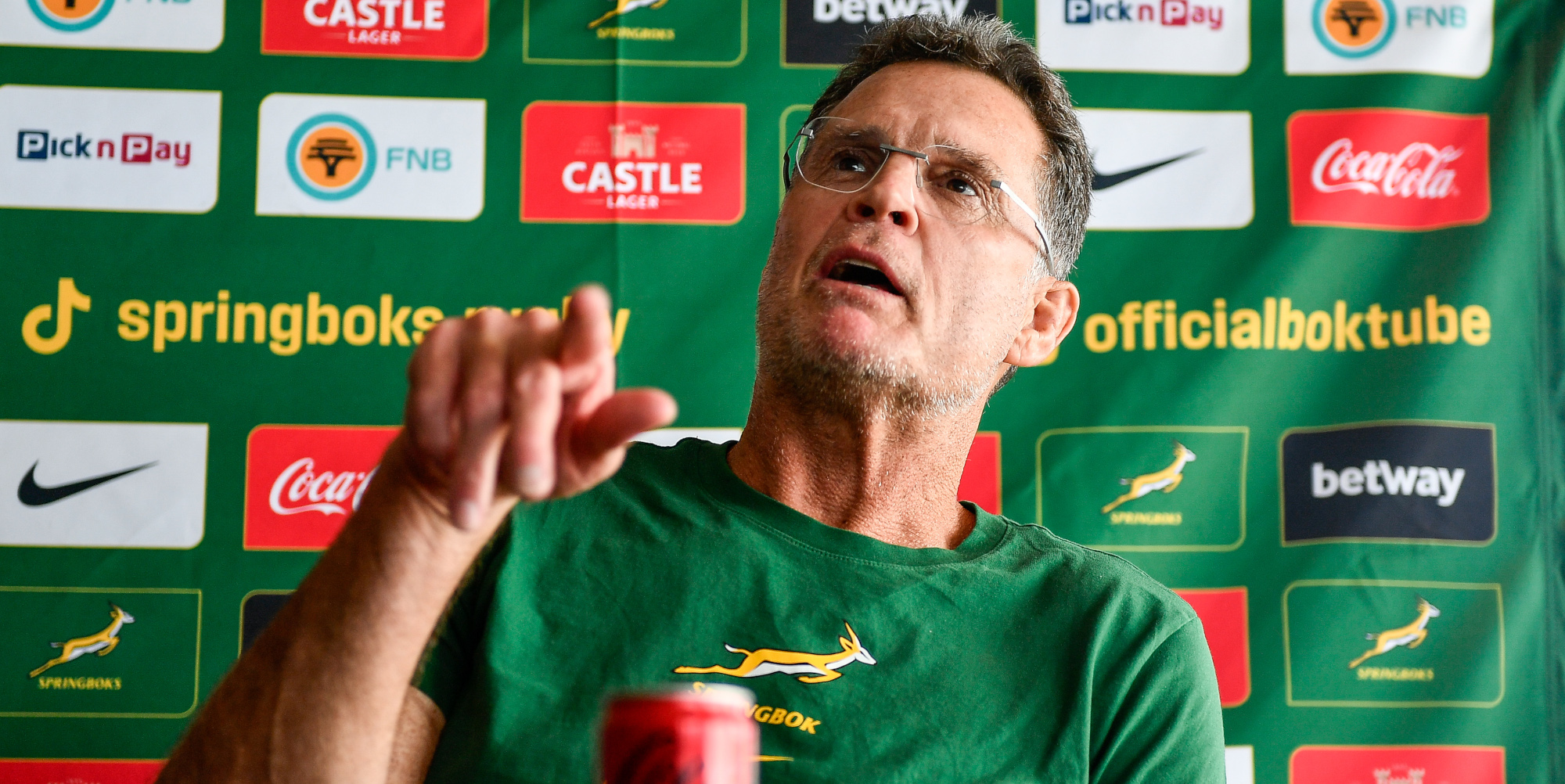
For one it fuelled a cryptic post by Springbok coach Rassie Erasmus, who was clearly not pleased with the different outcomes in two very similar cases that certainly, on first glance, makes it look like there are two sets of rules in rugby.
While Erasmus never made specific mention of the incident, the timing - just after the Furlong hearing’s outcome had been announced, makes it relatively clear he was referring to the incident as well.
“Back to Boardrooms again. Its so sick ! Tsek , Loop K@k !! I am so proud being 🇿🇦 I wonder if they proud🤔 A Wonder if they really sleep well. tnight🤔 ❤️🇿🇦❤️🤝🇿🇦” - was Erasmus’ tweet, echoing his earlier criticisms that South Africa often needs to win the boardroom battles as well just to have a level playing field in World Rugby.
This isn’t something new - there have been favouritism claims going back years for Ireland and its club teams - most notably Leinster - as the URC and World Rugby are both headquartered in the Irish capital. But the stark differences in outcomes - both players denied the incident, and in both cases there was not clear video evidence - is what makes it a bigger issue.
Jan-Hendrik Wessels, as you may recall - almost a day to the day earlier than Furlong - was accused of the same act in a URC game between the Bulls and Connacht and was - on the basis of the accusation and the citing commissioner’s report - given a nine week sentence, later reduced to eight.
Furlong walked away scot-free. And while it has little to do with Saturday’s crucial match in Dublin, it is worth revisiting what happened and understanding why the Boks feel this way, and why it certainly feels like the rules were bent so that one of Ireland’s key players could take the field for the team in Test matches again.
The Boks’ scrum in Dublin last year and the fact they repeatedly - and almost to their own detriment - opted for scrums from penalties - showed something more personal in this game than just a clear rivalry. Erasmus’ comments after the Furlong outcome take that further and that makes this weekend’s game far more interesting than just another test match.
For the Boks, whether right or wrong, there is a sense of injustice, and one that directly affects Ireland. And it will fuel their preparation for the game against the Irish, with the added weight of bouncing back from a sub-par performance in Paris.
So for those who are unaware, here is a run-down of why the two cases are so similar, and the outcomes so different, and why the Boks feel particularly aggrieved by this case. Comparing the two cases side by side, some interesting conclusions can be made.
1. Both cases had the same citing officer - Irishman Peter Ferguson. In Wessels’ case his report said he was at the match about 20 metres away and that his “direct line of sight corroborated” Murphy’s account.
He called Murphy’s testimony “consistent and credible” and Wessels’ arm movement “unnatural”. The panel listed Ferguson’s own eyewitness evidence as one of the foundations of the case. Wessels’ side argued he was too far away to have seen it.
In Furlong’s case Ferguson acted differently. This time he relied on the footage, the referee’s comments and Coombes’ statement. He did not claim to have seen it and gave no opinion on whether Coombes was credible. In short: in Wessels the citing commissioner acted as a witness backing the accuser.
In Furlong he did not.
2. One panelist sat on both cases. Wales’ Simon Thomas was one of the three panel members on Wessels case who banned him without clear evidence, and led the Furlong review, which was a unanimous finding.
3. Could the accuser be honest but mistaken? Wessels: several players in the ruck and any of them could have made contact.
The panel asked Murphy whether it could have been accidental, or a leg, foot or elbow. He said no, and that he turned and saw Wessels’ hand in his groin.
The panel accepted this as “clear, detailed and certain”. Furlong: his lawyer argued Coombes “could have made an honest mistake”. Coombes denied the pressure could have come from the grappling.
The panel found he “honestly, but mistakenly, believed” a hand had grabbed him, and that the pressure came from his own legs closing around Furlong’s arm. In short: both accusers insisted they were not mistaken.
Murphy was taken at his word. Coombes was overruled.
4. The accuser’s account changed Wessels: straight after the match Murphy said the grab lasted five seconds, then three to five, and he did not name Wessels.
At the hearing he was certain it was Wessels, saying he had since reflected and watched the footage.
The panel acknowledged the discrepancy on duration but said it was “not given significant weight”. Furlong: straight after the match Coombes told the citing commissioner he felt a hand “come up between my legs and grab”. He said he was “not sure” how long it lasted and did not name Furlong.
Two days later his written statement said it was a firm squeeze of his testicles lasting two or three seconds.
The panel said Furlong was “entitled to call into question the accuracy” of his evidence because of that gap, and that Coombes’ fear of accusing a high-profile player did not explain it. In short: both accusers gave a fuller, more certain account later than they did on the night. For Murphy the panel set that aside; for Coombes it counted against him.
5. The accuser’s reaction Wessels: Murphy struck Wessels with his forearm and was given a 20-minute red card, later rescinded.
The citing commissioner listed “Murphy’s immediate reaction” as evidence, and the panel described the strike as “a reaction to what has occurred”. Furlong: Coombes pushed the hand away, played on, and told his captain and the team doctor at the next stoppage.
Furlong’s lawyer put it to him that this was controlled and “somewhat muted”. The panel accepted he complained promptly and genuinely felt pressure, but said that did not show what caused it. In short: Murphy’s reaction was treated as evidence the grab happened. Coombes’ reaction was treated as proving only that he felt something.
6. Was the player believed? Wessels: he said his leg was trapped and he used his left arm to push down on it and free his knee. The panel said he “conducted himself well” and that his evidence was “credible”, but that it was “brief and not supported by any third party”.
It preferred Murphy. Furlong: he said it was a normal clear-out, hooking the leg as he is coached to do, and showed clips of other players doing the same.
The panel called his evidence “honest and straightforward” and preferred his account. No eyewitness supported him either. In short: both players were found credible. Only one of them was believed.
7. Admitting contact was possible. Wessels: he “accepted that it was possible for him to have touched the groin area” but said he did not.
The decision gives him no credit for it. Furlong: he said he was “100per cent” sure he did not make contact, “unless his hand brushed them on the way in”. The panel cited this as an example of him “making concessions where appropriate”.
In short: the same concession helped Furlong and did nothing for Wessels.
8. Character and record Wessels: he had two earlier red cards, in 2019 aged 18 and in 2021, described as a “relatively good record”. It was considered only when setting the length of the ban. Nobody gave character evidence for him. Furlong: he had 294 appearances with no red cards or citings, and the panel “took into account” that record “when considering this alleged act”.
The match referee, Andrew Brace of the IRFU, said he had “never had any issues with him on or off the field” and that he was “a pleasure to referee”. Leinster’s Guy Easterby called the allegation “quite inconceivable”.
In short: Furlong’s reputation was used to help decide whether he did it. Wessels’ record only affected his punishment.
9. The video Wessels: the citing commissioner said the footage was “not conclusive in capturing direct contact” and the arm was “partially obscured”.
The referee, TMO and both assistants found no clear evidence. The panel said his arm was where it was “possible” to reach, and that the video, “whilst not conclusive”, supported Murphy. Furlong: the panel’s own description was of his hand “between the legs and in or very close to the groin area” for about 3.5 seconds, and it said the footage “appeared to be consistent with the allegation” on first viewing.
After slow-motion review and still frames supplied by Furlong, it found his fingers were pointing downwards, “not consistent with a grip”.
In short: inconclusive video counted against Wessels. Video that first looked bad for Furlong was examined frame by frame until it cleared him. Bottom line Both cases came down to one player’s word against another’s, with inconclusive video. Murphy’s word was accepted and Wessels was banned. Coombes’ word was tested frame by frame and Furlong was cleared.