

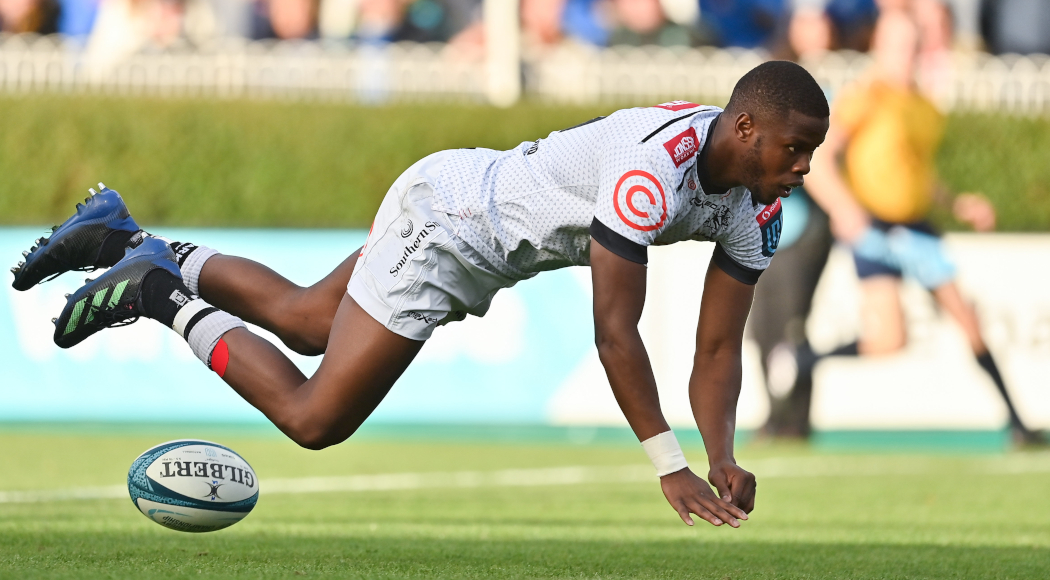
Cell C Sharks director of rugby Neil Powell made an interesting admission following his team’s 40-27 defeat to the Vodacom Bulls when it came to questions about the defensive weaknesses of fullback Aphelele Fassi.

The product of King William’s Town and Dale College has been setting games alight for a couple of seasons now with his sublime attacking talents, but his defensive frailty has become more and more of an issue and has started to silence those critics who clamoured so hard for his inclusion in the Springbok team.
You just can’t afford to have a fullback who makes the glaring defensive mistakes that Fassi does, and which were evident against the Bulls again in Pretoria just as they were in the Sharks’ previous Vodacom United Rugby Championship game against the Glasgow Warriors, when you play international rugby and the World Cup is on the line.
And until Fassi has started to make as much of an impact with his defensive game as he does with his attacking play, he will remain on the outer. Which ironically is exactly what has been said for a long time about another Sharks player, flyhalf Curwin Bosch, who was an outstanding schoolboy player and undoubted star of the future when he first got introduced to senior rugby but has just never developed due to him not being a complete player.
Sharks head coach Sean Everitt admitted at some point of last season that maybe the system failed Bosch. In the sense that he was pushed through into senior rugby too quickly and didn’t get enough opportunity to boss games, and develop the areas of his game where he lacked, by playing against his peers in age-group rugby before being promoted to the higher level.
Perhaps the same can be said for Fassi, who wasn’t long out of school when he first started playing for the Sharks. He has always belonged as an attacking force, but in those early days of his development it was clear he had a lot to learn both about defence and about positional play. Maybe he’d be more the finished article now had he served more of an apprenticeship at a lower level?
On Sunday Powell made the point, correctly, that it isn’t just Fassi who is making individual defensive errors, and it is a Sharks problem generally. But he admitted that perhaps more can be done to get Fassi up to speed so that he can be ready to graduate to the international level that his attacking skills suggest he should belong.
“From a defensive perspective there were a lot of players missed tackles, it was not just him (Fassi),” said Powel
“There were quite a few other guys as well. Maybe we are not giving them enough from a coaching perspective. We will make sure we address those areas when we come back after a bit of a break.”
Until he becomes a regular Bok, Fassi will spend most of his working life with the Sharks, so it will be the work he does with his franchise coaches, rather than with the national coaches, that will determine whether he can add to his three Springbok caps and become the force he could be at international level.
Powell admitted too that the Sharks might also need a bit of time to get the impressive former Lions flanker Vincent Tshituka properly absorbed into his new team’s playing systems.
“Vincent is still finding his feet. It is natural when you go to a new team and take on new and different responsibilities that you take time to settle in,” said the Sharks director of rugby.
“We have a bit of a break now and that will give us time to give him more clarity on his role and help him to get momentum and get his confidence back.”
The Sharks’ next URC game is the Sunday evening clash with Cardiff at Kings Park on 27 November.