Sacha's yellow card explained


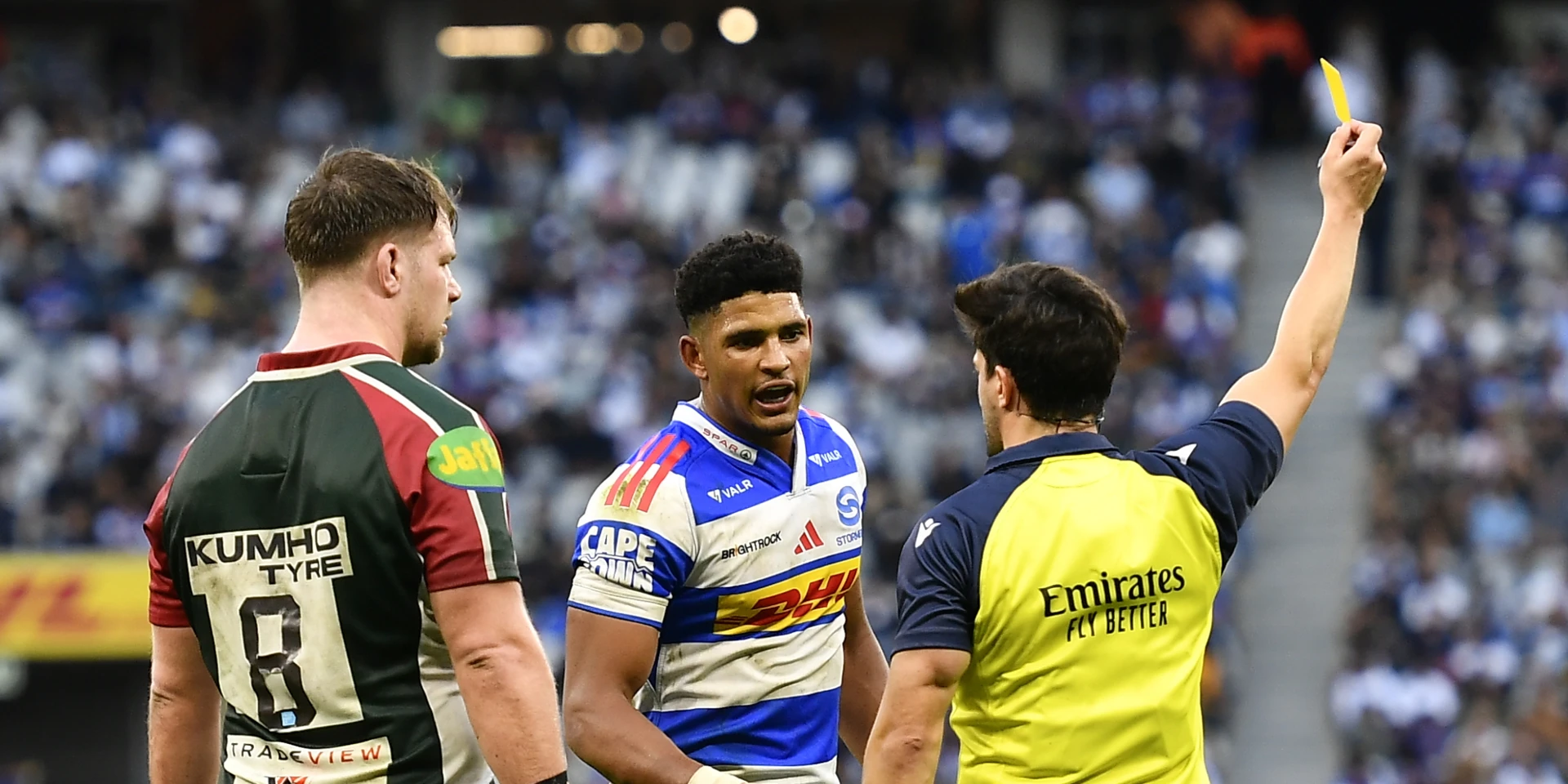
There was widespread debate among fans after DHL Stormers flyhalf Sacha Feinberg-Mngomezulu was shown a yellow card against Leicester on Saturday, with many questioning both the severity and the interpretation of the incident.
To understand why the officials reached their decision, it is important to unpack the laws involved and the process followed during the TMO review, rather than viewing the moment in isolation or through slow-motion alone.
Feinberg-Mngomezulu’s yellow card followed a TMO intervention that focused specifically on the shape of his carry and the use of his forearm in contact. Multiple broadcast angles were reviewed, giving the officials sufficient clarity to stop play and assess whether the action constituted dangerous play under World Rugby law.
Advertisement
Law 9.11 states that players must not do anything that is reckless or dangerous, including leading into contact with the elbow or forearm. In this case, Feinberg-Mngomezulu’s arm appeared detached from his body at the moment of collision. That separation is a key indicator referees use when judging whether a player is “leading” with the elbow rather than carrying naturally.
Law 9.12, which covers physical abuse, also became relevant during the review. Although there was no obvious striking motion, the forearm made the first significant point of contact with the defender. Under current interpretations, that brings the action into the category of an illegal strike, rather than a permissible bracing movement or fend.
From there, the officials applied the Head Contact Process (HCP), assessing the level of danger, degree of force, and any mitigating factors. While the incident did not reach the threshold for a red card - largely due to limited force and the absence of clear, direct head contact - it still met the standard for sanction. Under the framework, reckless actions that create avoidable risk can warrant a yellow card even without malicious intent.
Law 9.24 further reinforces this interpretation, stating that a hand-off is only legal if it does not involve excessive force or an extended elbow. The referee and TMO concluded that Feinberg-Mngomezulu’s action went beyond a legal fend and introduced unnecessary danger to the tackler.
While the decision was met with frustration in some circles, the yellow card was consistent with how the laws are currently applied, particularly in relation to ball-carrier responsibility and player safety.
The sanction was not a judgement on intent, but on risk and outcome - reflecting the modern emphasis on reducing preventable head and upper-body contact. In that context, the officials’ ruling aligned with both the letter and the spirit of the laws.
Here is the incident in full:
Advertisement