They lost but Marseille showed Boks the way forward


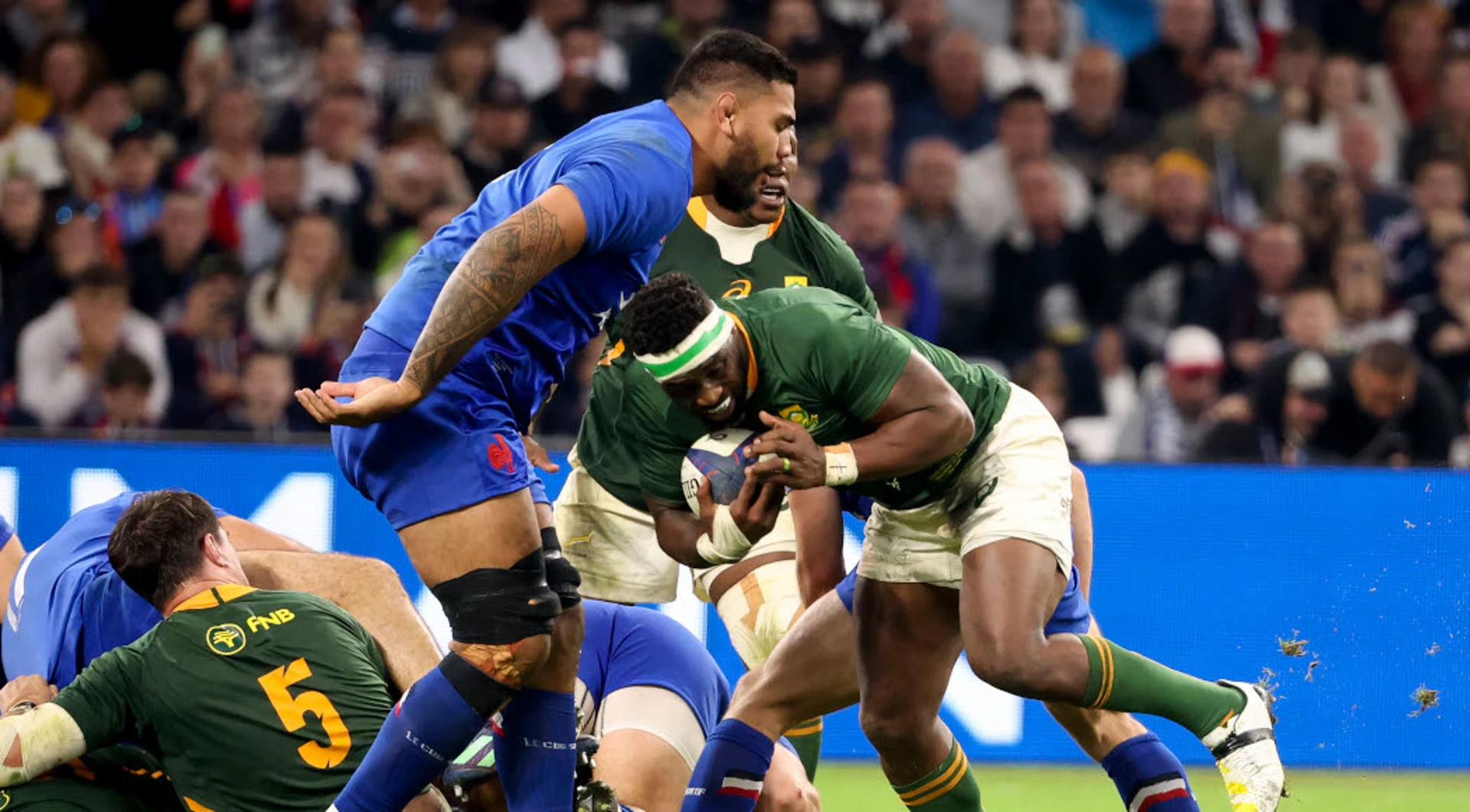
If the Springboks save what was started in Marseille to a possible next meeting against the French in the knock-outs of next year’s Rugby World Cup, they will be blowing a great chance to put themselves in the pound seats in their quest to retain the trophy they won in Japan.
Perhaps it was the red card shown to Pieter-Steph du Toit early in the game at a raucous Stade Velodrome in Marseille that pushed Siya Kolisi’s team towards producing under pressure the approach that could significantly strengthen their arsenal when they return to French shores 10 months from now.
Or perhaps it was always intended. I lean towards the latter, for the Boks did telegraph their intent to run the French kicks back at them during the build-up week. Why they’d be so vocal about it is anyone’s guess (what has happened to setting your opponents up?), but while the French appeared shocked when the Bok back three ran back at them and speeded things up by taking quick throws, it shouldn’t have been a shock to those of us who’d listened to the likes of Kurt-Lee Arendse in online media conferences.
Advertisement
UNIQUE FRENCH STYLE DEMANDED SOMETHING DIFFERENT
Head coach Jacques Nienaber said it at the team announcement press conference - the French are unique opponents and they’d demand something different from the Boks. Both Du Toit and Arendse followed up the following day by saying this would be a game where the Boks couldn’t bank on the physical superiority they usually do and would also have to think on the hoof as they’d only know on the day what the French would throw at them.
As it turned out the Boks did win the physical battle, but they lost the war. That war would probably not have been lost though were it not for Du Toit’s red card. Yes, the French also had a red card later, but the early one that consigns a team to playing more than 70 minutes with 14 men is always the most impactful.
CARDS ARE RUINING THE SPORT
Du Toit looked distraught and rightly so, for while the law was correctly interpreted by the referee, the law is an ass if it punishes a whole team for what was really an individual technical error - well with help from Kwagga Smith - and not an act of malicious intent. In both Du Toit’s instance and the incident that followed involving Antoine Dupont, the banishment from the field was correct, but for goodness sake, when are rugby’s rulers going to wake up and realise the plethora of cards is killing rugby.
Well, one of the things killing rugby, there are plenty of others, such as the time taken to set scrums and arrive at TMO decisions, the primacy of the driving maul as a scoring weapon, and the sheer lack of recognition in coaching boxes that aesthetic does matter if you want to sell the sport. If watching rugby wasn’t my work, I’d have switched channels and sports to the games at the Etihad and Anfield rather than watch the dross England and Japan dished up at Twickenham and Wales and Argentina in Cardiff.
But back to that issue of the cards. The Marseille game wasn’t the only one to be impacted by an early red this past weekend, it also happened in the Women’s World Cup final in New Zealand. Again, the error was individual and of a technical nature rather than malice. No-one who watched it would argue that the occasion was ruined, for it was an exciting game, and so was the one in Marseille, which joined the games in Firenze, where Italy beat Australia, and the one at Murrayfield on Sunday from saving the weekend from being a dead loss from a rugby viewpoint.
It did cast a bit of a shadow though and given how those cards disadvantage the teams that suffer them, they do too often turn an occasion into a non-event. The way around that is a simple one - replace red carded players from the bench after a period of 10 minutes. That way the offending player is still sanctioned, and the coaches won’t enjoy having to the timing of their replacements dictated to them, but it will preserve the sanctity of the contest.
WHY THE RED MIGHT HAVE BEEN A BLESSING
Yet if the Du Toit red card did accidentally cause the Boks to stumble on another way to play by forcing them to throw caution to the winds, then it was a blessing in disguise. It showed that adding more to their game could make the Boks a far more formidable force, and further growth in that direction will amplify their chances of success at the World Cup.
It won’t help them though if what we saw on Saturday night was the game the Boks reserve for the French, and then put it away in the interim before they play those opponents again. There was a high error rate from the Boks, something that might not have been the case had they been more used to playing that way by doing it more regularly.
While they definitely appeared to succeed in taking the French out of their comfort zone in Marseille, they also may have taken themselves out of their own comfort zone. You don’t want to risk that when you are playing a World Cup quarterfinal or semifinal, so hopefully against Italy in Genoa this coming weekend we will see the Boks retain elements of what they did against France.
CONFRONTED THE PRESSURE
Certainly if they do internalise what they learned from the Marseille experience, and it really couldn’t have been any tougher from a pressure viewpoint than being 13 points down and a man down against France at that venue, the frustrating narrow defeat would not have been in vain. It could be worth gold, and a significant signpost for Nienaber’s team on the road to the World Cup.
Not that the Boks don’t have a lot to think about. Their lineout is creaking a lot more lately than it used to, and they have an exiting problem in the absence of Handre Pollard and Elton Jantjies. The French won the game because that poor exiting was combined with the questionable yellow card shown to Deon Fourie with 10 minutes to go. If the Bok dugout made an error in Marseille, it may have been them not introducing the more ambidextrous Manie Libbok to the field a bit earlier than they did.
WATCH OUT FOR THOSE SCOTS - AND ITALY
The defeat means the Boks have played the two teams ahead of them on the World Rugby rankings away from home and have lost by three points and four points respectively, both of them games that could just as easily have been won. Every test and every result should matter, and too much focus on the World Cup is not good for the sport, but when it comes to looking ahead to the global tournament, the Boks do have much to be positive about.?The French won but they might well have sustained a bit of a dent to their confidence with the way they struggled when for the first time confronted by a team who can beat them physically. If the Boks do bump them again next year, they certainly won’t be going in lacking in confidence.
On the point of the World Cup, these two games have also thrown up something else - the possible irrelevance of the big Pool meeting next September with Ireland. If the Boks beat Scotland, a win over Ireland is less imperative because finishing first or second in the group doesn’t make much difference if you consider that either way you are going to see one of New Zealand or France in the quarterfinal.
So a win over the Scots is an imperative, but that is not the gimme it used to be, as the Scots showed in pushing the All Blacks all the way in Edinburgh on Sunday. Gregor Townsend’s team showed that on their day they can be competitive against anyone, as indeed did Italy in beating Australia for the first time in their history.
Italy are in the same group/pool as France and New Zealand at next year’s World Cup, and on the evidence of what they did in Firenze, they could be more of a thorn to those two favoured teams than they were to the Boks and All Blacks when they were in the same pool in Japan.
WEEKEND AUTUMN SERIES RESULTS
Ireland 35 Fiji 17
Italy 28 Australia 27
Wales 20 Argentina 13
England 52 Japan 13
France 30 South Africa 26
Scotland 23 New Zealand 31
Advertisement