Advertisement
Advertisement
Oakmont Country Club Course Guide
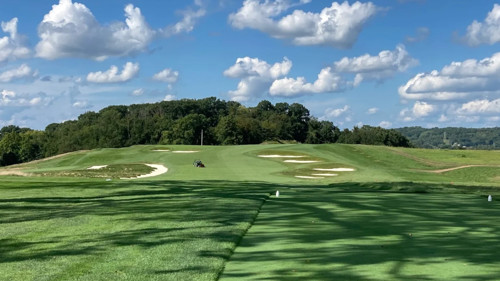
Oakmont Country Club is a country club in the eastern United States, located mostly in Plum with only a very small portion of the property located in Oakmont, suburbs of Pittsburgh in western Pennsylvania.
Established 122 years ago in 1903, its golf course is regarded as the "oldest top-ranked golf course in the United States,"and was designated a National Historic Landmark in 1987.
The Pennsylvania Turnpike separates seven holes (2–8) from the rest of the course.
The course is also noted for its slope. In particular, on holes 1, 3, 10, and 12, the greens pitch away from the fairway.

HOLE-BY-HOLE GUIDE
Par 70 | 7 431 yards
HOLE 1
PAR 4 | 488 YARDS
Nothing says “Welcome to Oakmont” quite like the opening hole, one of the toughest starts in major championship golf. The narrow fairway is lined by bunkers on both sides. The downhill approach is to a green that is partially blind and slopes away from the fairway. The ideal shot is short the green to allow the slope to carry it onto the green.
HOLE 2
Par 4 | 346 YARDS
Short but difficult, accuracy is everything on a shot that has five bunkers on the right and a ditch to the left. The green has bunkers on both sides, and the putting surface slopes sharply from back to front, with several undulations. The USGA likely will move the tee forward for one weekend round and tempt players to try to reach the green.
HOLE 3
Par 4 | 462 YARDS
The famous Church Pew bunkers are on the left side. The deep bunkers on the right are no picnic, either. The second shot with a short iron is uphill, making it a blind approach to a green that slopes gently away from the fairway. Anything short could roll back down the hill. Anything long will go through the green to a closely mown area.
HOLE 4
Par 5 | 611 YARDS
The Church Pews are still on the left side as this par 5 runs adjacent to the previous hole, with more deep bunkers on the right. A big drive in the fairway allows for players to go for the green in two. Otherwise, laying up requires a shot that must avoid bunkers on the right, though that’s the best angle to approach the green.
HOLE 5
Par 4 | 408 YARDS
Another short par 4 that plays tough. The fairway narrows about 160 yards from the green, and the approach shot is to a green that is well below the fairway. This is where Dustin Johnson’s ball moved on the green, eventually leading to a two-shot penalty that wasn’t assessed until after he had won.
HOLE 6
Par 3 | 200 YARDS
The first par 3 is slightly downhill to a narrow green that slopes toward the tee. The worst place to miss is the bunker to the right.
HOLE 7
Par 4 | 485 YARDS
The fairway is parallel to the Pennsylvania Turnpike and is pinched by deep bunkers. The approach is to a green that slopes from back to front, and staying below the hole is important. Missing to the left is the toughest spot from which to save par. This was the hardest green to hit in 2016 among par 4s.
HOLE 8
Par 3 | 289 YARDS
This par 3 is so long that a good short game is required. At full length, it is the longest in U.S. Open history. While the green is open, a bunker juts out some 80 yards before the green. Carry that, and the ball is likely to run all the way onto the green. The putting surface is not as heavily contoured as others at Oakmont. Expect the hole to tip out at 300 yards one round just because.
HOLE 9
Par 4 | 472 YARDS
This hole runs the other direction next to No. 1, with a narrow landing area that can’t be seen from the green. There is a ditch left and bunkers to the right, and the fairway slopes to the right. The green is large and unlike any other — the back portion, which is in play, is the practice green.
HOLE 10
Par 4 | 461 YARDS
The tee shot is downhill to a narrow landing area, and the fairway slopes from right to left. Now there is a ditch intersecting the fairway for anyone driving it too far. There are deep bunkers on the left side of the fairway. The green slopes from front right to back left, and it is among the hardest at Oakmont.
HOLE 11
Par 4 | 400 YARDS
The tee shot is uphill toward the clubhouse, so the landing area can’t be seen from the tee. The green is slightly diagonal and guarded by deep bunkers. This should yield more birdies than usual for Oakmont. After the previous four holes, it might feel like a breather.
HOLE 12
Par 5 | 632 YARDS
The longest hole on the course, so the power hitters might have a chance to reach in two, but keeping it in the fairway is difficult because the ball rolls out. Second shots are played to a narrow landing area guarded by ditches and bunkers. The green slopes from front to back. This should be a true three-shot hole and all the shots have to be precise..
HOLE 13
Par 3 | 182 YARDS
The shortest of the par 3s typically plays the easiest. The green is surrounded by bunkers, some that appear to be as large as the green. The putting surface slopes from back to front, and it is critical to be below the hole for a good chance at birdie.
HOLE 14
Par 4 | 379 YARDS
The fairway slopes from right to left and narrows about 270 yards from the tee, just as a group of bunkers ends. The green is long and divided into sections by ridges. Because players will have a wedge, this should be a shot easily controlled.
HOLE 15
Par 4 | 507 YARDS
The longest par 4 on the course, this has a blind tee shot to the landing area, and the fairway slopes to the right. The approach is to a green that is deepest on the course and framed by one of the longest bunkers at Oakmont.
HOLE 16
Par 3 | 236 YARDS
The large green has a deep bunker on the right. But anything to the left makes for a tough par save because the green slopes to the right. Anyone choosing to play short of the green has a straightforward shot at saving par. Larry Nelson holed a 60-foot birdie putt here on his way to victory in 1983.
HOLE 17
Par 4 | 312 YARDS
The large green has a deep bunker on the right. But anything to the left makes for a tough par save because the green slopes to the right. Anyone choosing to play short of the green has a straightforward shot at saving par. Larry Nelson holed a 60-foot birdie putt here on his way to victory in 1983.
HOLE 18
Par 4 | 402 YARDS
The closing hole is renowned for great drives by the winners, Angel Cabrera in 2007 and Dustin Johnson in 2016. The tee shot must be long and straight, and it narrows about 260 yards off the tee. The second shot is uphill to a large green so undulated that playing it safe could also mean the player faces a difficult two-putt.
Advertisement